Termite Droppings: What They Look Like and What They Mean
Termite droppings, also called frass, are tiny hard pellets. Each one has six flat sides, and UC IPM says that shape is diagnostic for drywood termites. They pile up on the floor or sill below a pinhole in the wood.
Difficulty: easy. Call a pro if you find six-sided pellets that keep coming back after you clean them up, mud tubes on the foundation, or winged termites indoors. Drywood and subterranean termites both need a licensed professional.
Not every termite leaves them. Subterranean termites, the kind that live in the soil and build mud tubes, don’t leave piles of pellets at all. This guide shows what drywood termite pellets look like, the four things people confuse them with, and a free test for whether the termites are still active.
In this guide:
- What Termite Droppings Look Like
- Which Termites Leave Droppings?
- Termite Droppings vs. Look-Alikes
- Are the Termites Still Active? A Free Test
- What to Do Next
What Termite Droppings Look Like
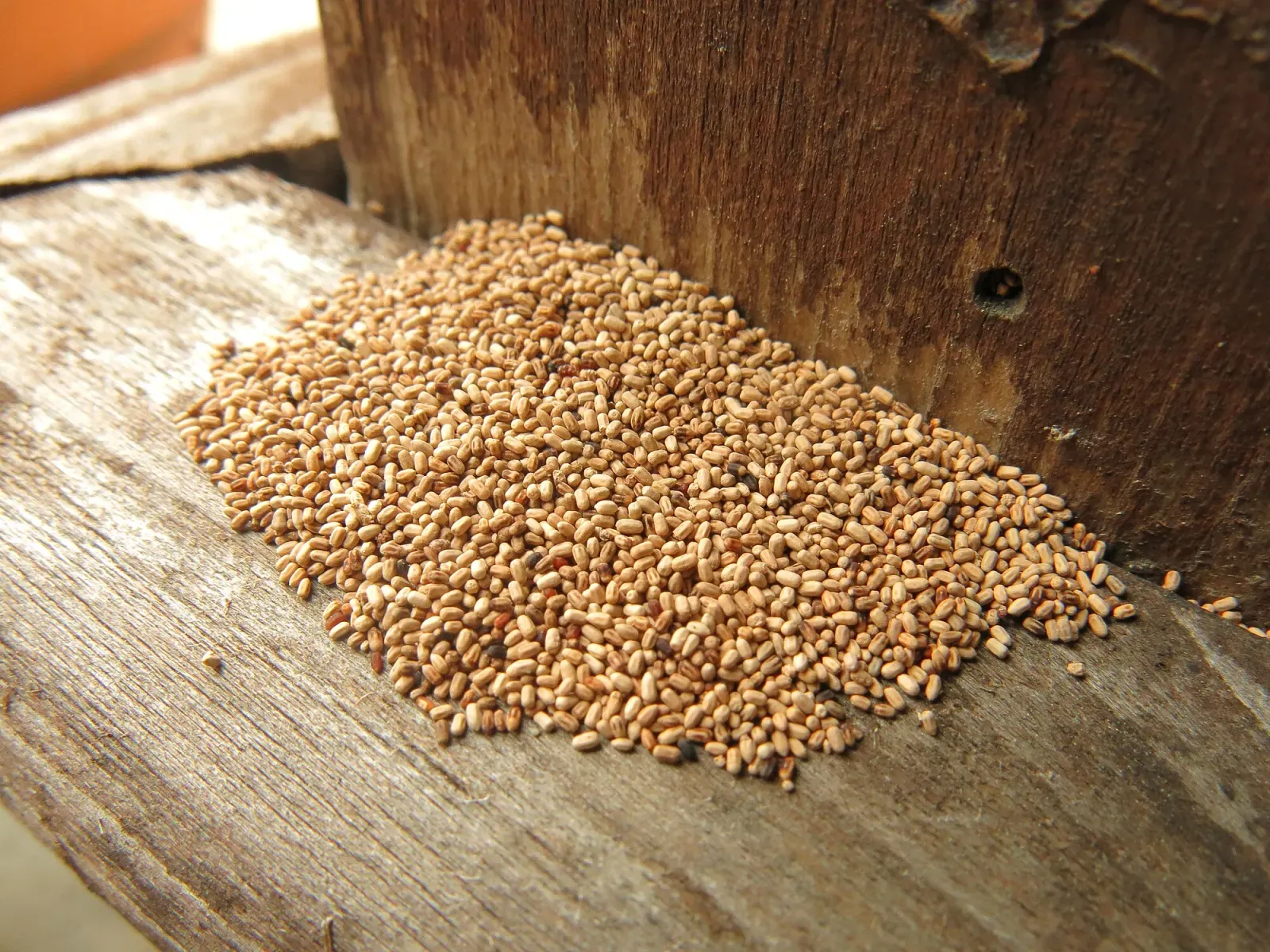
Drywood termite pellets pushed out of the wood above. Photo: Sanjay Acharya (CC BY-SA 3.0), via Wikimedia Commons.
From the University of Florida and UC IPM:
- Shape: hard pellets with six flat sides and ridges along their length. A magnifier shows this best.
- Feel: gritty when you roll them between your fingers.
- Color: light brown to almost black. The University of Florida says the color doesn’t depend on the age or color of the wood, so a pile can be mixed.
- From a distance: a small pile that looks like sawdust or coffee grounds.
- Where: on floors, sills and shelves below the infested wood. Termites push the pellets out through “kick-out holes” about the size of a pencil tip, 1 to 2 mm across (University of Florida).
Drywood termites infest dry, sound wood: framing, window sills, doors, trim, flooring, furniture and attics (University of Florida). So the pile is often on a windowsill, under a beam or below a piece of furniture.
Which Termites Leave Droppings?
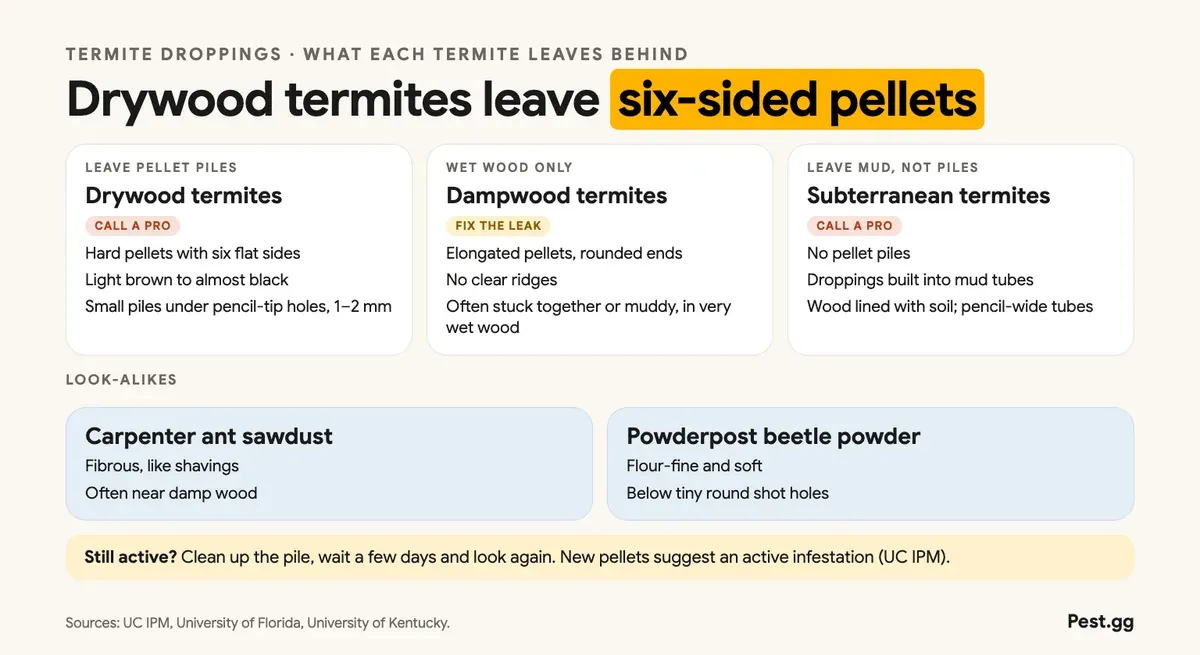
Infographic: what each termite leaves behind, plus the two most common look-alikes. Sources: UC IPM, University of Florida, University of Kentucky.
| Termite | What you find |
|---|---|
| Drywood | Piles of hard, six-sided pellets below small holes (UC IPM, Univ. of Florida) |
| Dampwood | Elongated pellets, rounded at both ends, without the ridges (UC IPM) |
| Subterranean | No piles. Droppings are mixed into mud tubes and tunnels (Univ. of Florida) |
Drywood termites live inside the wood they eat and don’t need soil (UC IPM). They push their pellets out through small surface openings, and the pellets build up on surfaces below (UC IPM). In California, UC IPM says they are most common in southern California and along the coast; the University of Florida lists several species in Florida.
Dampwood termites need very wet wood. Their pellets are often stuck to the tunnel walls or turn into a muddy paste (University of Florida). Fixing the water problem is the main step (UC IPM).
Subterranean termites live in the soil. The University of Florida says their droppings are sticky and built into their mud tubes and tunnels, so you won’t find a pile. Look instead for:
- Mud tubes about the width of a pencil on the foundation, piers or joists (University of Kentucky).
- Wood hollowed out along the grain, with bits of dried mud or soil inside (University of Kentucky).
- Winged termites, or their shed wings, on windowsills (University of Kentucky).
Termite Droppings vs. Look-Alikes
Four things are easy to mistake for termite droppings:
- Carpenter ant sawdust. Carpenter ants dig wood but don’t eat it. UC IPM says their sawdust is fibrous, unlike the six-sided pellets of drywood termites. Their nests usually start in damp or decayed wood (University of Kentucky). See carpenter ants vs. termites.
- Powderpost beetle powder. It’s flour-fine and sits below tiny round shot holes (University of Kentucky). It feels soft, not gritty.
- Plain sawdust or dirt. Sawdust from drilling or sanding has no regular shape. Rub a pinch between your fingers: termite pellets feel gritty (University of Florida).
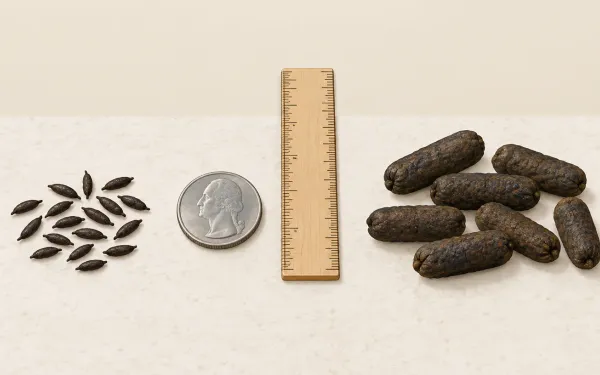
- Mouse droppings. These are much bigger: 1/8 to 1/4 inch long, dark and pointed at the ends (Cornell). See mouse poop vs. rat poop.
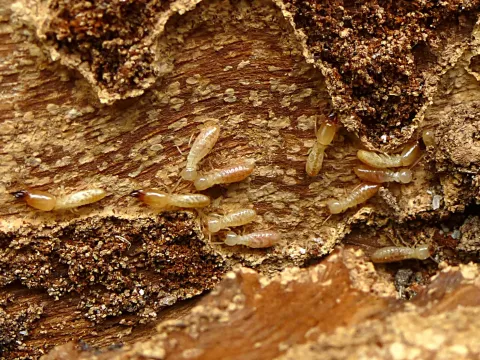 Call a proDrywood termitesLive inside dry wood; push out pellets.
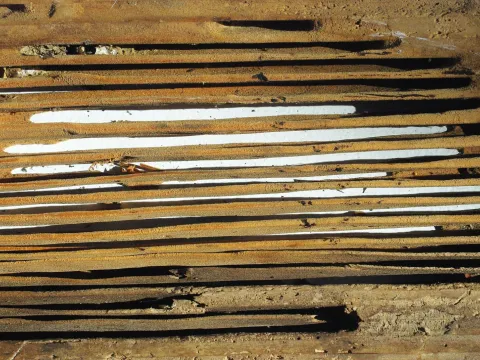 Carpenter ant damageClean tunnels; sawdust pushed outside.
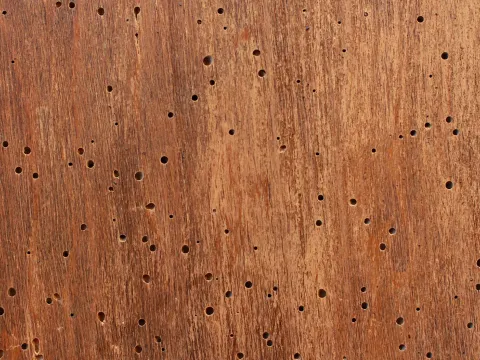 Beetle holesTiny round holes; flour-fine powder.
More debris and holes are sorted in holes in wood and pest droppings.
Are the Termites Still Active? A Free Test
Pellets alone can’t tell you whether termites are still there. UC IPM says you can’t judge from pellets alone whether an infestation is active or how far it reaches.
UC IPM’s simple test:
- Clean up the pellets with a vacuum or a damp paper towel. Take a photo first.
- Wait a few days.
- Look again. New pellets in the same spot suggest an active infestation.
A few pellets can also fall out when a house shifts or vibrates (UC IPM), so one or two grains is not proof. A steady new pile is.
What to Do Next
Found six-sided pellets?
- Don’t spray. UC IPM says the products that control drywood termites aren’t available to homeowners, and home-use spot products are not effective.
- Save a sample in a small bag or on tape for the inspector.
- Get three inspections. UC IPM recommends getting at least three inspection reports before you choose. Inspectors look for pellets, kick-out holes, shed wings and damage.
- Ask about whole-house vs. spot treatment. UC IPM says whole-structure treatments (fumigation or heat) treat hidden infestations too; spot treatments only work where the termites are found.
Found mud tubes or soil in wood? That’s subterranean termites. The University of Kentucky says treatment is a job for a professional. Learn the signs and the bugs in what do termites look like.
Common questions
Tiny, hard pellets with six flat sides, light brown to almost black, in small piles like coffee grounds (University of Florida, UC IPM). That is drywood termite poop. Subterranean termites don’t leave piles.
We found no extension or government source saying drywood termite pellets are a health hazard. Clean them up with a vacuum or a damp towel, and keep a sample for the inspector.
Pellets mean drywood termites are or were in the wood right above the pile. To check if they are still there, clean the pile and look again in a few days (UC IPM). An inspector can find how far it goes.
Light brown to almost black. The University of Florida says the color isn’t linked to the age of the pellets or the color of the wood.
Sources and further reading · 7
- UC IPM: Drywood Termites: six-sided pellets are diagnostic, kick-out holes under 2 mm, dampwood pellets, clean-and-check test, no homeowner products, get three reports.
- UC IPM: Subterranean and Other Termites: drywood pellets on surfaces, subterranean tubes.
- University of Florida: Drywood and Dampwood Termites (ENY-211, archival copy): pellet color and texture, coffee-ground look, pencil-tip holes 1–2 mm, where drywood termites live, subterranean frass in mud tubes.
- UC IPM: Carpenter Ants: fibrous sawdust vs. pellets.
- University of Kentucky: Termite Control, Answers for Homeowners (EF604): mud tubes, damage lined with soil, treatment by a pro.
- University of Kentucky: Powderpost Beetles (EF616): flour-like powder and shot holes.
- Cornell IPM: Mouse and Rat Biology and Behavior: mouse dropping size.