Mold Mites: What They Are and How to Get Rid of Them
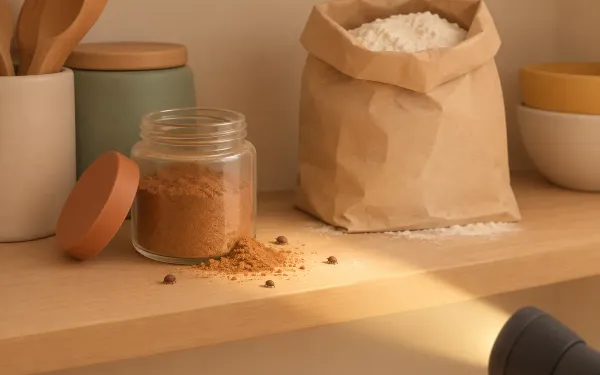
Mold mites are tiny, pale mites that feed on mold. You usually see them as “dust that moves” on a shelf, a bag of flour or pet food, or a damp wall. Iowa State University Extension says they are harmless to people, pets, furniture and the house itself.
Cost: about $10–50 hygrometer in supplies. Difficulty: easy. Call a pro if the mites keep coming back after you’ve thrown out the food and the humidity stays above 60%, or you find mold growing on walls or ceilings. That is a moisture problem, and a contractor may need to find the leak.
They are a sign, not the main problem. Iowa State says mold mites only develop where there is moisture or high humidity. Spraying without fixing that gives only temporary control. Below: how to tell them from look-alikes, and a 4-step fix.
In this guide:
- What Mold Mites Look Like
- Where Mold Mites Come From
- Mold Mites or Something Else?
- Are Mold Mites Harmful?
- How to Get Rid of Mold Mites
What Mold Mites Look Like
- Very small. One mite is barely visible. Purdue Extension describes the closely related grain mite as 1/50 inch, pale grayish white and soft-bodied.
- Pale. Iowa State says mold mites can be brown, off-white or light yellow.
- In crowds. You notice them because there are thousands. Washington State University says an infested surface can seem to move.
- “Mite dust.” Heavy infestations leave a pale brownish layer under and around the food. UC Davis says this dust is made of live and dead mites, shed skins and droppings.
“Mold mites” is a group name. Iowa State says it covers several similar species that are hard to tell apart, including the cheese mite, flour mite and grain mite. The most common pantry species is Tyrophagus putrescentiae (UC Davis).
Where Mold Mites Come From
Mold mites need damp air, and they eat the mold that grows in it (Iowa State). They don’t come from the mold itself. They are already common and go unnoticed until conditions let them multiply.
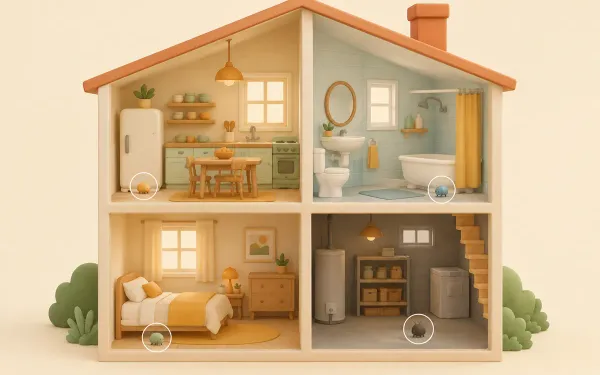
Places they show up, from Iowa State, UC Davis and Washington State:
- Food: flour, grain, cereal, baking mixes, dried fruit, cheese, nuts, seeds and dried meat.
- Pet and bird food: dry pet food and bird seed.
- Around the house: damp wallpaper, furniture, straw and bulbs.
- Nests: bird and small mammal nests.
The University of Kentucky says that under hot, humid conditions, huge numbers can build up fast. A female grain mite lays up to 800 eggs, and egg to adult takes about two weeks at room temperature.
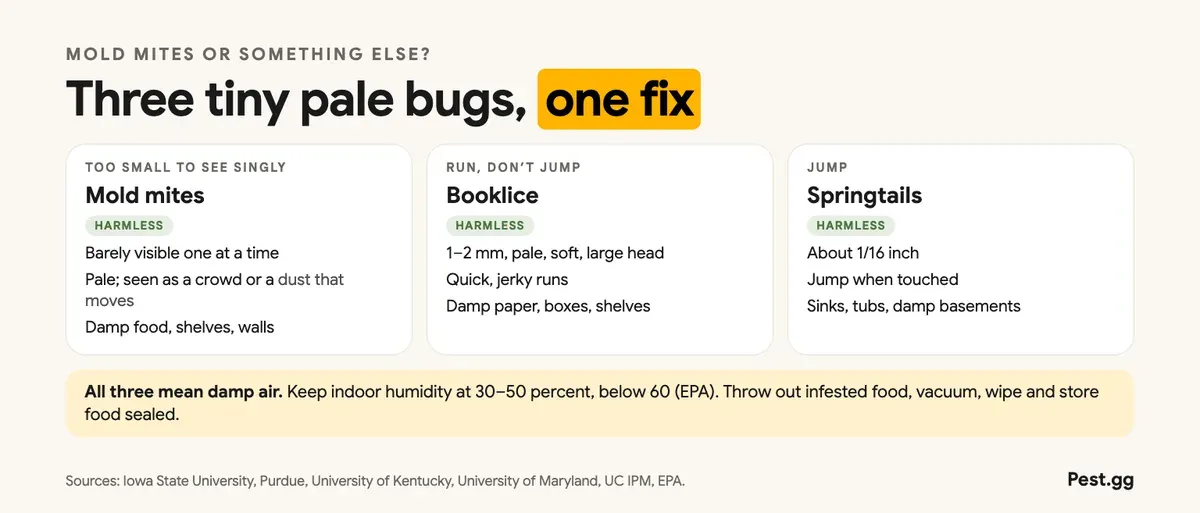
Infographic: mold mites and the two pale bugs most often confused with them. Sources: Iowa State, Purdue, University of Kentucky, University of Maryland, EPA.
Mold Mites or Something Else?
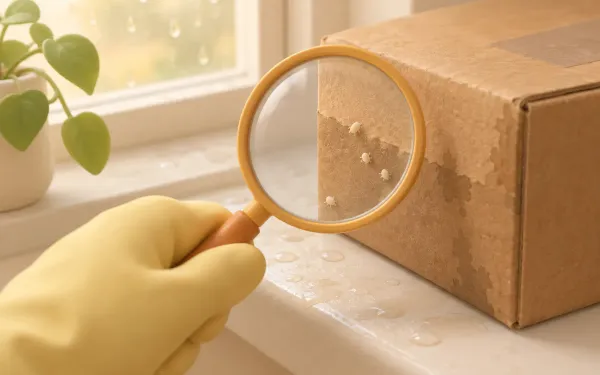
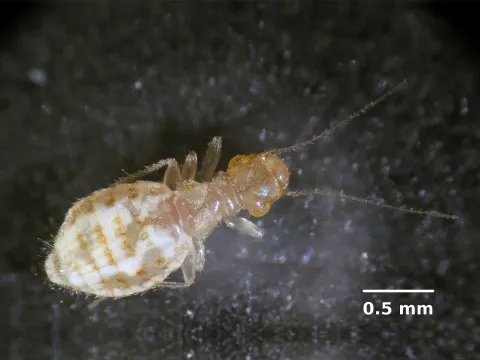
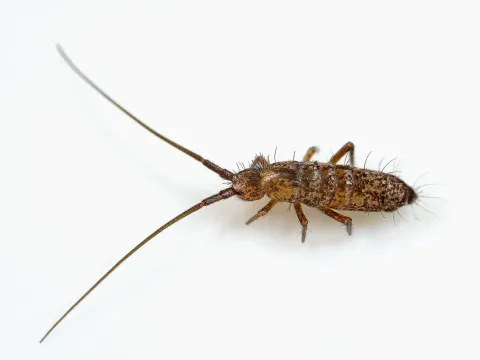
Three tiny pale bugs turn up in the same damp places. A magnifier or your phone’s zoom helps.
- Mold mites: almost too small to see one at a time. Look for a crowd or a moving dust.
- Booklice: 1 to 2 mm, pale, soft, with a large head. They run in quick jerks, often on damp paper and boxes.
- Springtails: about 1/16 inch. They jump when you touch them, often near sinks, tubs and basements.
All three point to the same thing: too much moisture. For other pale bugs, from mealybugs to bed bug nymphs, see tiny white bugs.
Are Mold Mites Harmful?
Mostly no. Iowa State says they are harmless to people and pets and don’t damage furniture, clothing or the house. UC Davis says they are not parasites; they feed on mold.
Two points to know:
- Skin. Washington State says long contact with infested food can cause a skin irritation called grocer’s itch. UC Davis notes skin and breathing problems in people who handle infested materials. If you have a rash or breathing trouble, ask a doctor.
- Food. Throw out infested food. Washington State says the molds the mites feed on in animal feed may produce toxins.
The bigger worry is the dampness itself. EPA advises keeping indoor humidity below 60 percent, ideally 30 to 50 percent, to limit mold.
How to Get Rid of Mold Mites
- Find and throw out the source. Check every bag and box near the mites: flour, cereal, pet food, bird seed. The University of Kentucky says the dust usually means a heavily infested item is close by. Seal it in a bag and take it outside.
- Vacuum, then wipe. Use the crevice tool on cracks and shelf edges. Then wipe every surface with hot, soapy water and let it dry fully (University of Kentucky, UC Davis).
- Store food sealed. Put flour, cereal and pet food in containers with tight lids. Kentucky says some mites always survive cleanup, so sealed containers stop them from reaching new food. UC Davis says food you want to keep can be frozen for a week first.
- Dry the air. This is the step that keeps them gone. Get a hygrometer (EPA says $10 to $50) and keep humidity at 30 to 50 percent. Fix leaks, open storage areas to air and run a fan or dehumidifier. Our guide to using a dehumidifier for bugs covers sizes and running costs.
Skip the bug spray in the kitchen. The University of Kentucky says insecticides are not recommended in kitchens or food storage areas, and that cleanup, sealing and ventilation bring the problem under control. Washington State gives the same advice.
Mites on walls or furniture, not food? Look for the damp spot: a leak, a cold wall with condensation, new plaster still drying or a musty closet. Iowa State says spraying without fixing the moisture only gives temporary control.
Mold mites often travel with pantry bugs. If you also see beetles or moths in food, see tiny brown bugs in the house.
Common questions
They are not parasites (UC Davis), and Iowa State says they are harmless to people and pets. Long contact with heavily infested food can irritate the skin (Washington State), which is not the same as a bite.
Barely, one at a time. Most people notice a group, or a fine pale dust that moves. A magnifier makes them easier to see.
Not while the air stays damp and there’s food or mold for them. Once you throw out the source and bring humidity down, their numbers drop. Kentucky says young mites can rest for several weeks when conditions are bad, so keep up the cleaning and sealed storage for a while.
Sources and further reading · 6
- Iowa State University Extension: Mold Mites: colors, species group, damp conditions, harmless, fix the humidity first.
- University of Kentucky: Grain Mites (EF629): 800 eggs, two-week life cycle, mite dust, cleanup steps, no insecticides in the kitchen.
- Washington State University: Mites in Stored Foods: foods they infest, surfaces that move, grocer’s itch, sealed storage.
- UC Davis Bohart Museum: Mold Mites: Tyrophagus, mite dust, high-fat foods, freezing food for a week.
- Purdue Extension: Grain Mite (E-222): size and color.
- EPA: A Brief Guide to Mold, Moisture and Your Home: humidity below 60 percent, ideally 30 to 50; hygrometer cost.