Ant Traps: Which Kind Works, and Where to Put Them
Most “ant traps” are bait stations. Ants carry the bait home and share it with the queens and young, which kills the colony (UC IPM). That’s why they work better than spray. UC IPM calls baits the only type of insecticide recommended for ants in most situations.
Time: about 5–10 days to see fewer ants. Difficulty: easy. Call a pro if ants are still trailing after several weeks and two different baits, you find carpenter ants and sawdust, or you suspect fire ants near where children play.
But not every trap does this. Some fast-acting products kill the ants before they get home, and some granules sold near the baits are not baits at all (UC IPM). This guide covers which kind to buy, where to put it, why you’ll see more ants at first, and what natural repellents can and can’t do.
In this guide:
- How Ant Traps Work
- Types of Ant Traps
- What to Look for on the Label
- Where to Put Ant Traps
- Natural Ant Repellents: What Works
- Common Questions
How Ant Traps Work
- Ants find the bait and recruit other workers to it (UC IPM).
- Workers carry it home and pass it mouth to mouth to other workers, larvae and queens (UC IPM).
- It must be slow-acting. Otherwise the workers die before they get back to the nest (UC IPM).
So more ants at first is a good sign. The University of Kentucky says to expect more ants around the bait at first and not to spray them. UC IPM says it can take 5 to 10 days to see fewer ants, and several weeks or more for full control.
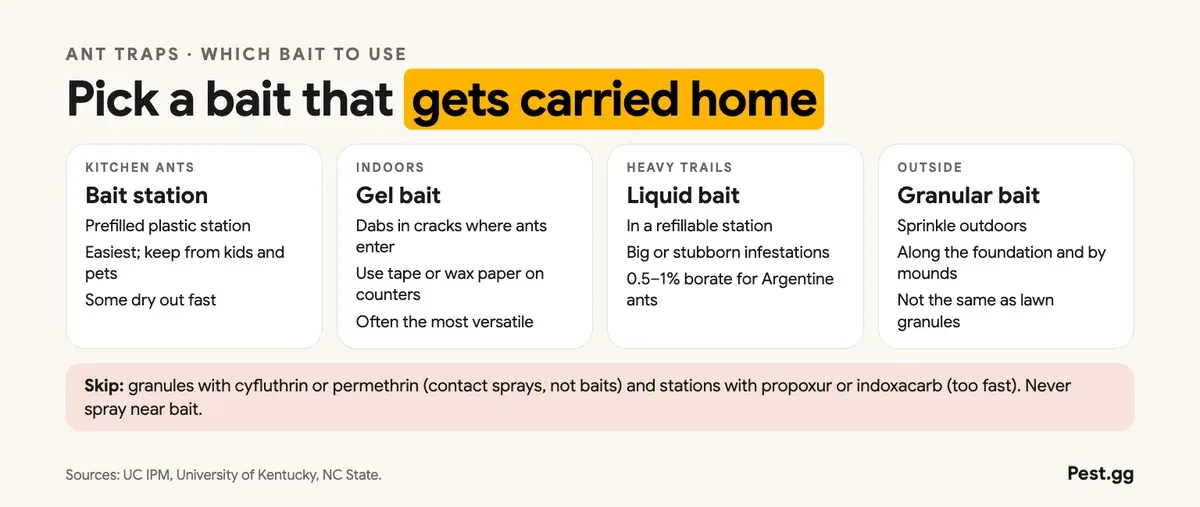
Infographic: the four bait types and what to skip. Sources: UC IPM, University of Kentucky, NC State.
Types of Ant Traps
- Bait stations. Small prefilled plastic stations. UC IPM says they’re the easiest and quite safe if kept away from children and pets. Some dry out fast and need replacing.
- Gel baits. Squeezed from a tube or syringe into cracks where ants come in (UC IPM). The University of Kentucky says these are often the most versatile and effective. Put dabs on masking tape or wax paper to protect counters.
- Liquid baits in refillable stations. Best for big or stubborn infestations (UC IPM). For Argentine ants, UC IPM recommends low-strength liquid borate, 0.5 to 1% in sugar water. Stronger 5.4% borate stations kill foragers in the house but are less effective on a major infestation.
- Granular baits. Sprinkled outdoors along the foundation, by mounds or along pavement cracks (University of Kentucky, NC State). They’re different from granular lawn insecticides (NC State).
Sticky traps and sprays kill only the ants they touch. Only bait carried home reaches the colony (UC IPM).
What to Look for on the Label
- Labeled for ants. Check that ants are on the label (UC IPM).
- Slow-acting ingredients such as hydramethylnon, fipronil, boric acid or other borates, or abamectin (UC IPM).
- The right food. Baits use sugars, proteins or oils. Odorous house ants and Argentine ants take sweet baits; pharaoh ants and thief ants prefer protein or greasy baits; fire ants prefer oily baits (UC IPM, University of Wisconsin).
What to skip, per UC IPM:
- Granules with cyfluthrin or permethrin. They look like baits but are contact insecticides that kill foragers without controlling the colony.
- Bait stations with propoxur or indoxacarb. UC IPM says they aren’t very effective because the ingredient acts too fast.
Not sure what ant you have? Offer a little sweet, protein and oily bait side by side and see which they eat (UC IPM).
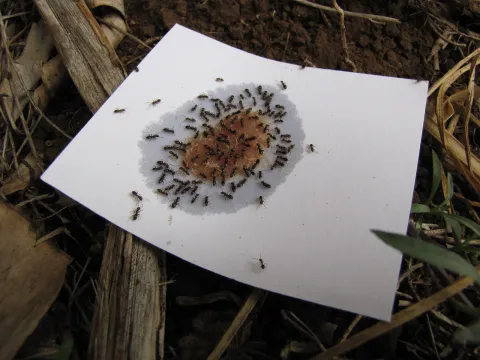 Ants at baitA crowd at the bait means they’re feeding.
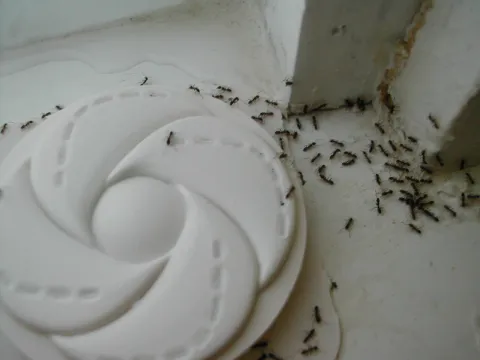 Argentine ants at a stationSweet liquid baits work well for them.
Where to Put Ant Traps
- Right next to the trail. Put baits beside the trails the ants follow (University of Kentucky), near where they enter.
- Outdoors first. UC IPM says to use baits mainly outdoors, every 10 to 20 feet around the foundation and at nest openings. Outdoor bait draws ants out of the house. Use indoor baits if the infestation is serious and you can’t find where they come in.
- Away from kids and pets. Outdoors, stations can be hidden in mulch (UC IPM).
- No spray or cleaner around the bait. It keeps ants away from the bait (University of Kentucky, NC State).
- Remove other food. Clean up crumbs and sweet spills so the bait is the best meal around (UC IPM).
- Refill when empty. If ants ignore it, move it or try a different product (UC IPM).
Timing helps too: baiting in late winter and early spring, when colonies start to grow, works best (UC IPM).
Natural Ant Repellents: What Works
Repellents can clean up ants you see, but they don’t kill the colony. What extension guides say:
- Soapy water. Wiping trails with soapy water removes the scent trail. UC IPM says it may be as effective as a spray for removing foraging ants for a while.
- Plant oils. Products with peppermint, rosemary, clove, orange or thyme oil kill ants on contact but don’t last long (UC IPM).
- Petroleum jelly or caulk. UC IPM suggests plugging entry points with caulk or petroleum jelly.
- Sticky bands on trees. A band of sticky material such as Tanglefoot around a trunk keeps ants out of trees and shrubs (UC IPM).
- Diatomaceous earth. A desiccant dust that works when it stays dry (UC IPM). Avoid breathing it.
Other home remedies like vinegar, cinnamon or coffee grounds come up often, but we found no extension guide that tests them against ants.
For the kitchen ants most people call sugar ants, see how to get rid of sugar ants. For big black ants and sawdust, see how to get rid of carpenter ants.
Common questions
That’s the bait working. The ants are recruiting nestmates to carry it home. The University of Kentucky says not to spray them; activity usually drops in a few days to weeks.
About 5 to 10 days to see fewer ants, and several weeks or more for full control (UC IPM).
Prepackaged stations are quite safe if kept away from children and pets (UC IPM). Put them where pets can’t reach, and follow the label.
They can if you put them indoors when ants aren’t already coming in. UC IPM says to use baits mainly outdoors, so they draw ants out.
Sources and further reading · 5
- UC IPM: Ants: how baits work, bait types and strengths, ingredients, what to skip, placement, timing, soapy water, plant oils, sticky bands.
- University of Kentucky: Ants (EF619): gel baits, placement beside trails, more ants at first, granular baits outdoors.
- NC State Extension: Biology and Control of Carpenter Ants: no spray near bait, granular baits vs. granular insecticides.
- UC IPM: Carpenter Ants: diatomaceous earth.
- University of Wisconsin: Odorous House Ants: sugar-based baits.