Best Rat Bait for Traps (Food, Not Poison): What Works
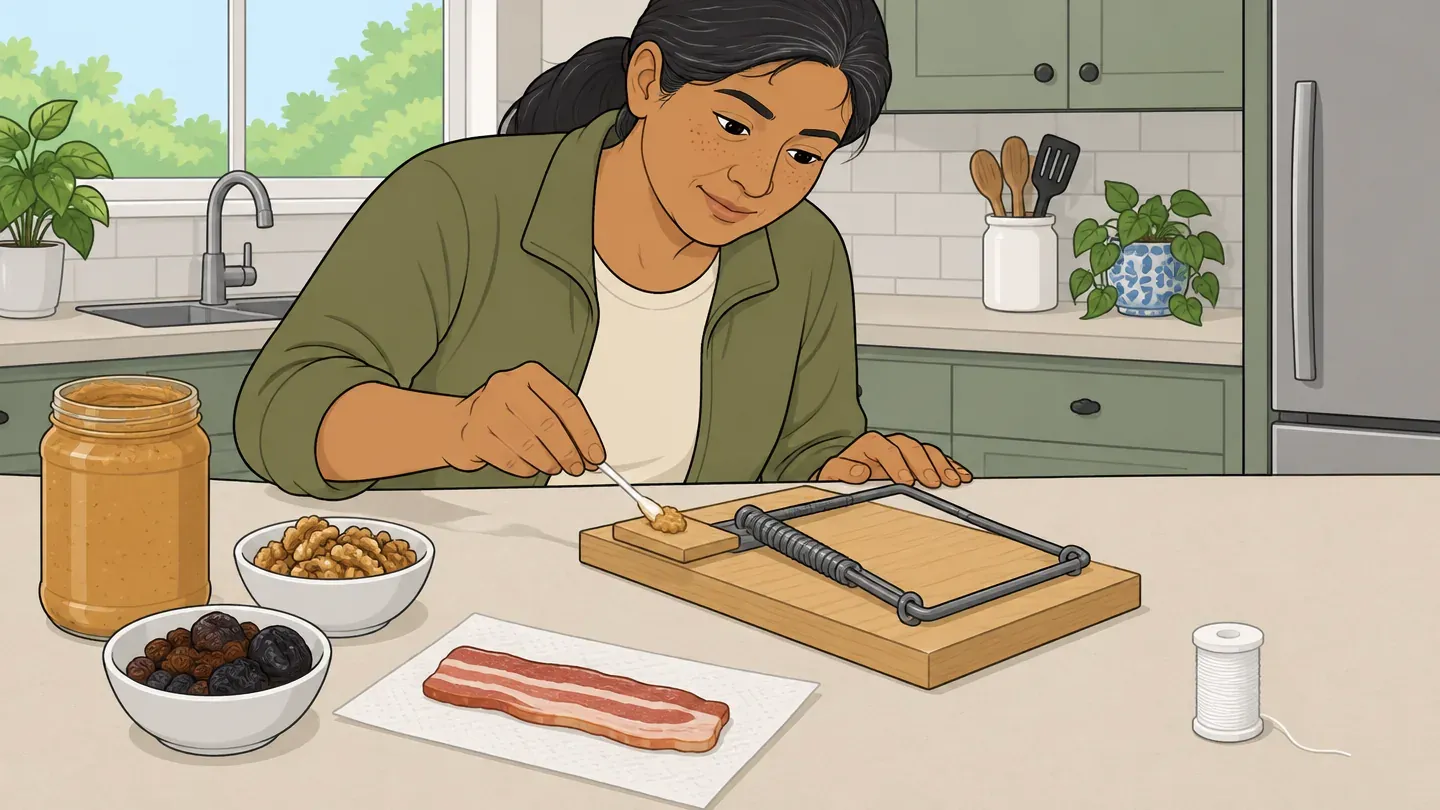
Illustration: a small dab on the pedal, with other kitchen baits ready if the rats snub peanut butter.
The best rat bait for a snap trap is food, not poison: a pea-sized dab of chunky peanut butter, or a nut, raisin or strip of bacon tied to the trigger. If rats ignore it, use the food they’ve been raiding. Leave traps baited but unset until the bait is taken, then set them all at once.
Cost: about $22–43 in supplies. Difficulty: moderate. Call a pro if bait keeps disappearing and fresh droppings keep turning up after 15 days of trapping; the CDC suggests professional help when trapping doesn’t solve it.
This guide compares six trap baits, shows how to fix each one to the trigger, and matches them to your rats and your home. It combines CDC, UC IPM and wildlife-control guidance, plus the trap maker’s instructions, with what we saw in our own field testing: six months and dozens of wild mice and rats, recorded on security cameras at real sites. Looking for poison bait blocks instead? See why we don’t recommend rat poison and how rat bait stations work.
What Is the Best Bait for Rat Traps?
Chunky peanut butter first, then the food your rats are already eating. The same kitchen foods top government and university lists:
| Bait | When to use it |
|---|---|
| Chunky peanut butter | First choice; it presses into the trigger |
| Nuts, such as a walnut half | Rats are raiding nuts or birdseed; tie it on |
| Raisins, prunes, dried fruit | Roof rats, or rats eating fruit off trees |
| Bacon, hot dog, pepperoni | Norway rats, or rats raiding garbage |
| A piece of dry pet food | Rats are eating from the pet bowl |
| Store-bought non-allergenic trap bait | Someone in the home has a nut allergy |
Peanut Butter: The Default Rat Bait
Chunky peanut butter is the first bait the CDC names for snap traps. Press a pea-sized dab into the grooves or bait cup of the pedal, not on top, so the rat has to work at it.
Best for: your first round of traps, in almost any home.
Main limitation: not for a home with a peanut allergy.
Nuts: Tie Them On, Don’t Balance Them
A walnut half or other nutmeat works well, especially where rats are raiding nuts or birdseed. Solid bait slides off a pedal, so tie it to the trigger with thread or fine wire.
Best for: rats that are eating nuts or seed near the droppings.
Main limitation: skip it if anyone has a tree-nut allergy.
Dried Fruit: The Roof Rat’s Favorite
For roof rats, the ICWDM finds raisins, prunes, peanut butter, nutmeats and gumdrops “often better than meat or cat food baits.” Tie a raisin or prune on the same way as a nut.
Best for: slender rats in attics, or rats eating fruit off trees.
Main limitation: it dries out, so refresh it at least weekly.
Bacon and Meat: For Norway Rats Near Garbage
UC IPM says Norway rats prefer grains, meats, fish and nuts. A strip of bacon, hot dog or pepperoni tied to the trigger suits rats raiding garbage.
Best for: stocky rats on lower floors, garages and basements.
Main limitation: meat spoils fast; replace it when it goes moldy.
Pet Food: Use What They’re Already Stealing
Norway rats accept whatever food is abundant and easy to get, UC IPM says. If you find chewed pet food or birdseed near fresh droppings, a fresh piece of that food is the best rat bait for your rats.
Best for: homes where the pet bowl is the rats’ main meal.
Main limitation: it only helps if that’s what they’re eating.
Non-Allergenic Trap Bait: For Allergy Homes
Store-bought non-allergenic baits are made for homes with a nut allergy, the ICWDM notes. Bacon and dried fruit avoid peanuts too, but check labels.
Best for: a home with a peanut or tree-nut allergy.
Main limitation: you have to buy it, unlike kitchen baits.
Keep the Bait Fresh, and Switch When It Stops Working
The ICWDM’s trapping steps include refreshing and replacing bait as needed, and it notes that rats prefer fresh, high-quality food and reject spoiled food when they have a choice. Swap out bait that has dried, gone moldy or rancid, or been crawled over by insects. If rats stop taking a bait that used to work, try a different food; we saw the same thing in our own testing, below.
What We Saw in Our Own Field Testing
We tested trap baits ourselves for six months, watching on security cameras at real sites; most of the animals were wild rats. Three things stood out. These are our own observations, not a controlled study:
- Scent alone doesn’t work. Scented lures by themselves didn’t draw rats to the trap. Real food did.
- High-energy food works best. A piece of Snickers bar, fried bread and peanut butter all got taken. Of the baits we used most, a small piece of Snickers bar worked best on our rats.
- Rats switch tastes. A bait that worked could stop working. Switching to a different food brought them back.
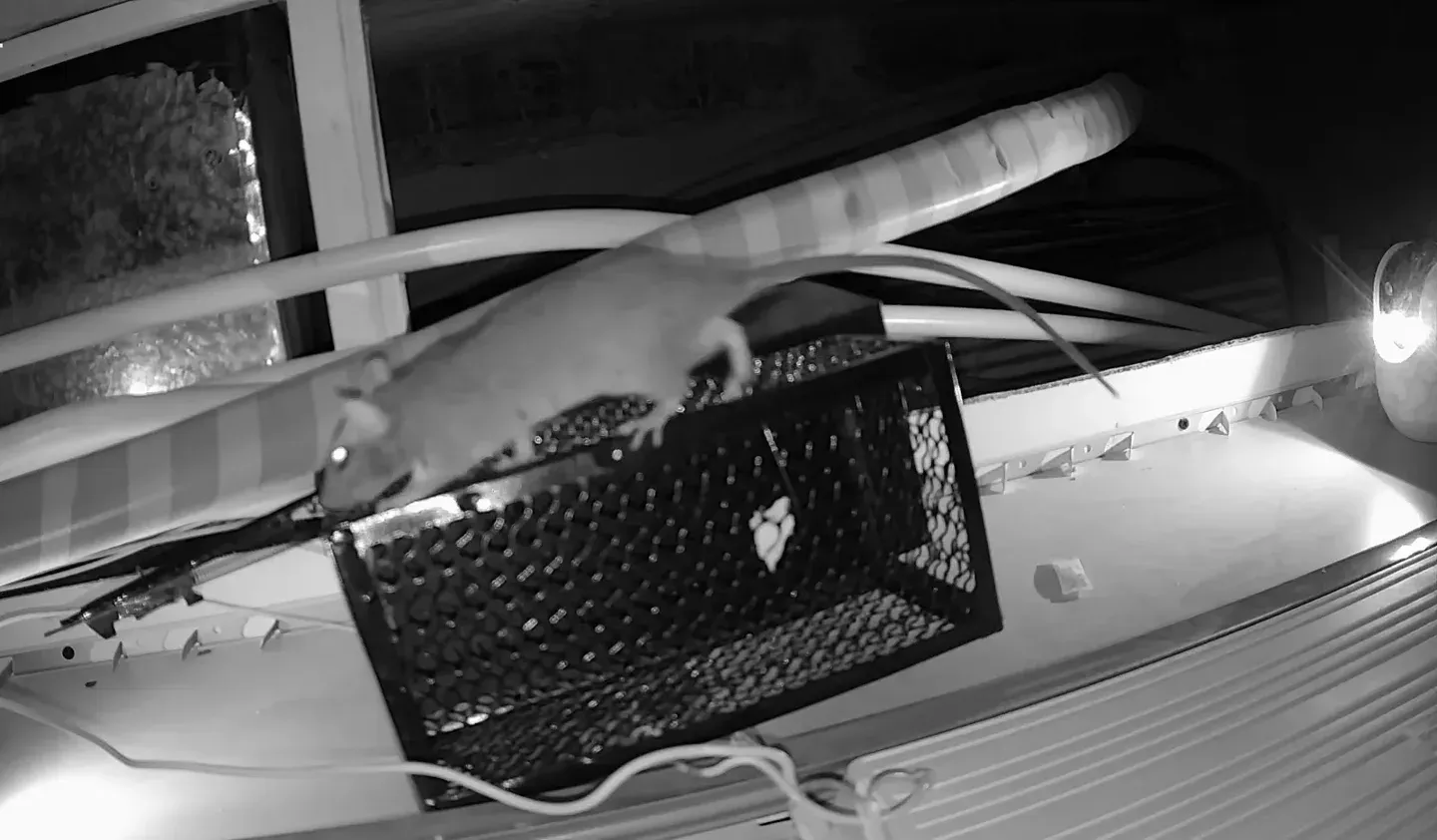
Security camera still from our field testing: a wild rat climbing over a mesh cage trap.
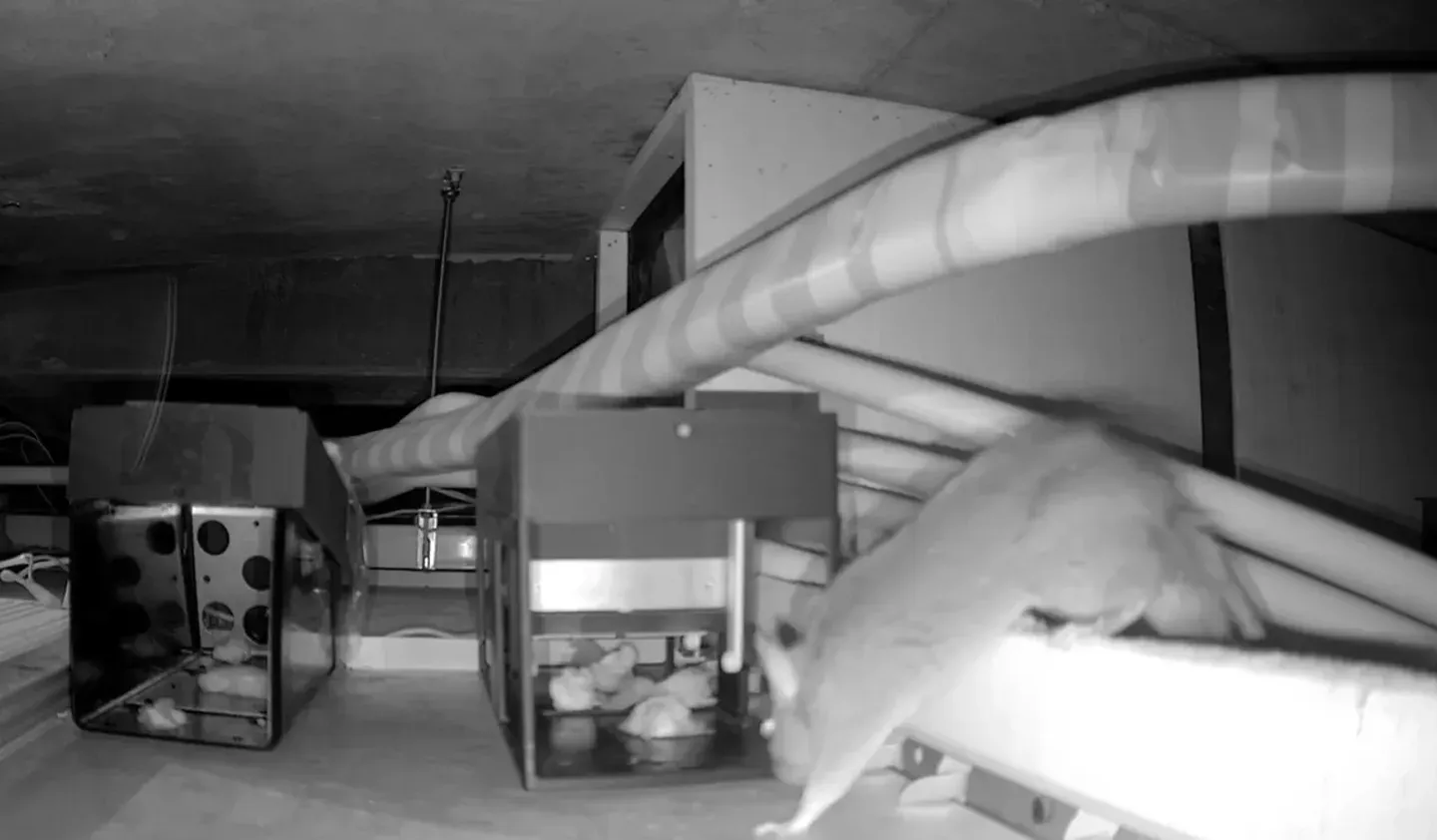
Security camera still from our field testing: a wild rat heading toward a metal box trap baited with bread.
If you use chocolate, keep the traps away from dogs: chocolate is toxic to dogs (FDA).
How to Bait a Rat Trap
Bait size and setup matter more than the bait. A Reddit poster’s complaint is the common one: “Both traps got set off and the peanut butter was gone, but nothing captured.”
Step 1: Use a pea-sized amount. UC IPM says “it is important to use just a pea-sized amount.” A big glob lets a rat feed around the edges and never press the pedal.
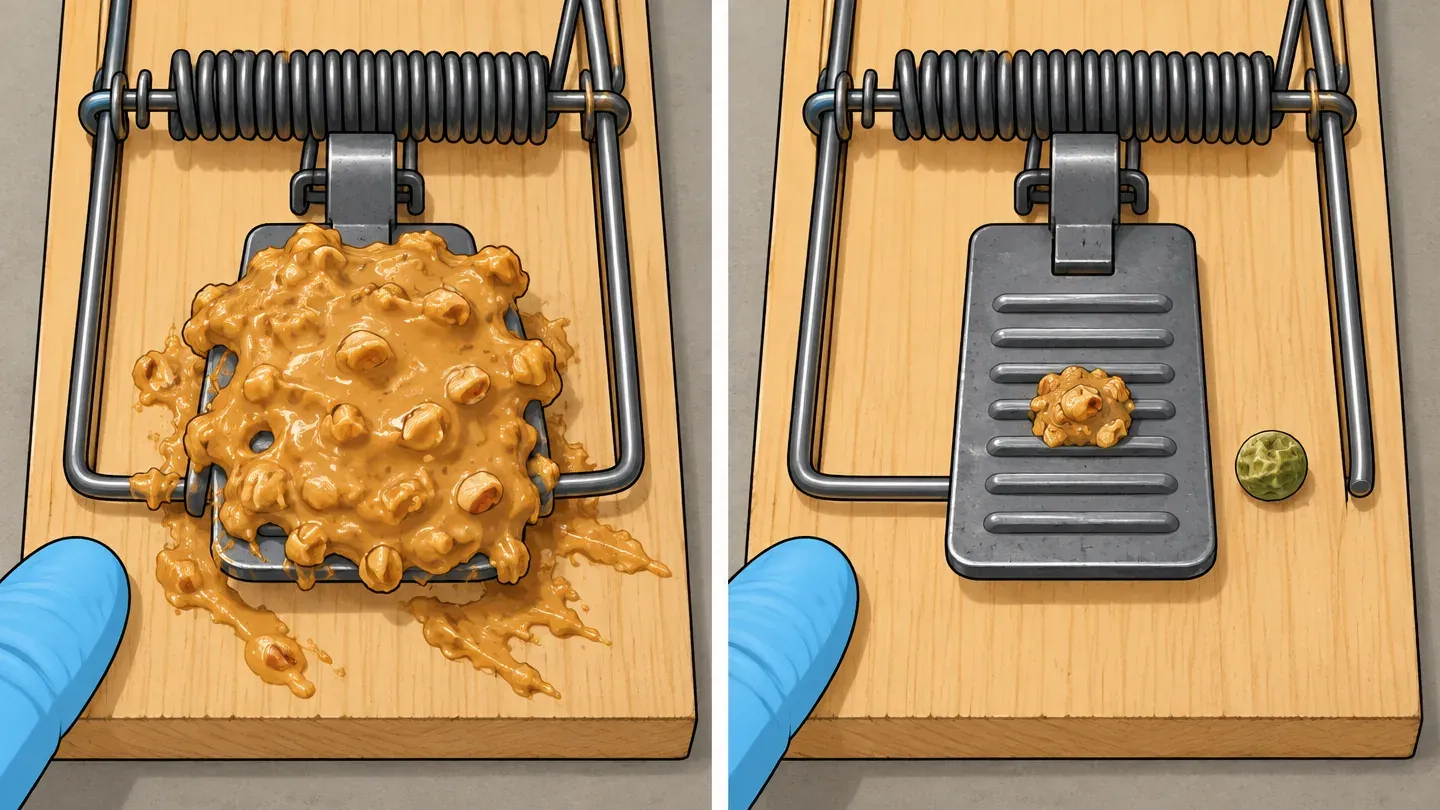
Illustration: a glob spilling over the pedal (left) and a pea-sized dab pressed into it (right).
Step 2: Tie solid bait to the trigger. Use light string, thread or fine wire while the trap is unset, so the rat springs the trap trying to pull it free. If bait still vanishes, a stiff trigger or a trap lying parallel to the wall is the usual cause; why traps take the bait without catching walks through every fix.
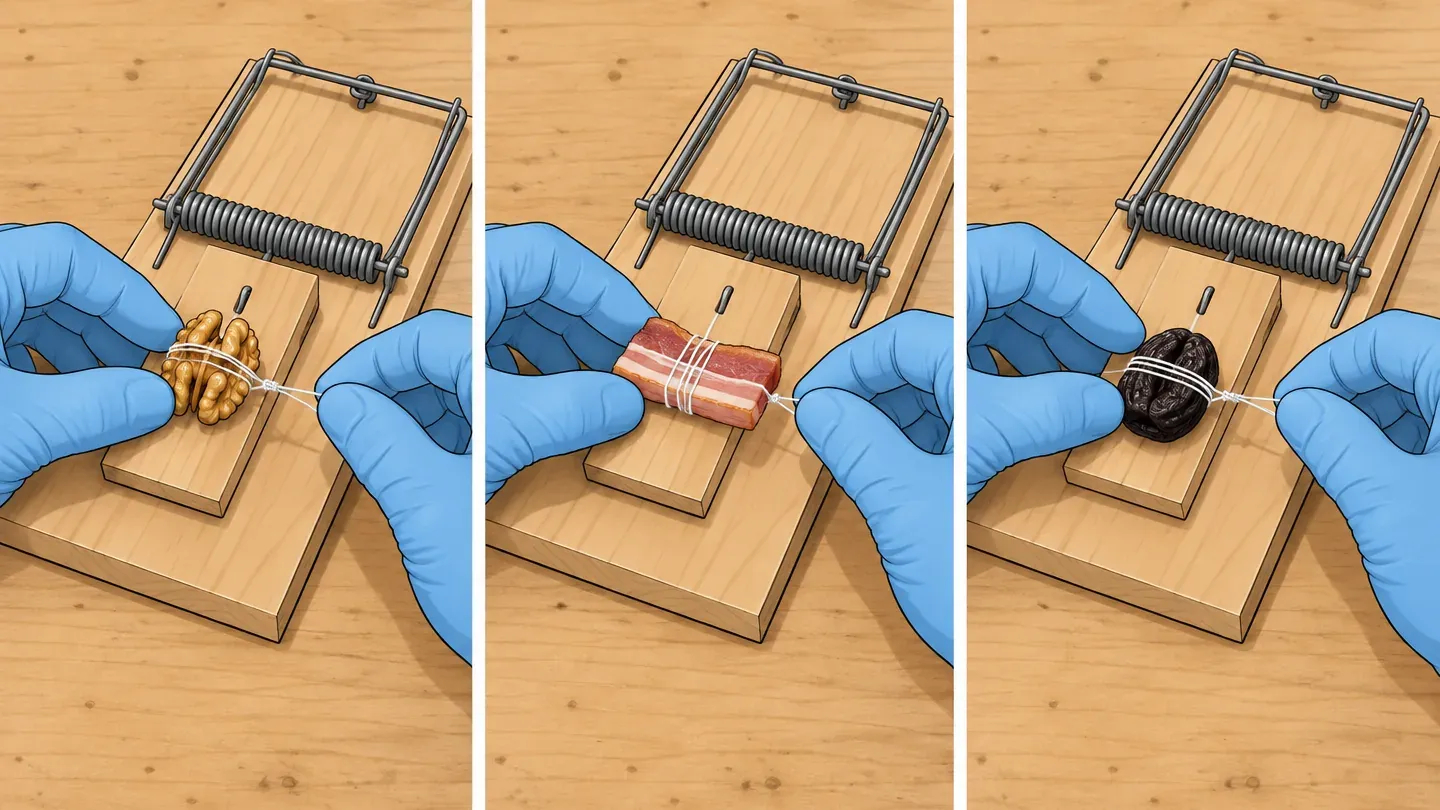
Illustration: thread wrapped around a walnut half, a strip of bacon and a prune on three trap triggers.
Step 3: Place the traps, still unset. Put them on the floor where you’ve found droppings or gnaw marks, at a right angle to the wall with the bait end touching it, so trap and wall form a “T”. For roof rats, use shelves, ledges and beams. UC IPM spaces rat traps about 10 to 20 feet apart and adds more whenever every trap is emptied.
Step 4: Set them all the same night. A rat that springs a trap and escapes is very hard to catch again, and rats may take several days to approach a new trap, the CDC says. Once the bait has been taken, add a fresh dab and set every trap that night; how to catch a rat shows how to arm one safely, and why rats avoid traps covers shy rats.
Step 5: Check daily, refresh the bait weekly. Check traps every morning, and replace the bait at least once a week, or sooner if it dries out, goes moldy or gets dusty. Rats prefer fresh food when they have a choice.
Caught one? Wear disposable gloves and seal it in a plastic bag before it goes in the trash. To reuse a trap, scrub it with hot water and a stiff brush; dead-rat odor isn’t known to put other rats off, the ICWDM says. Don’t sweep or vacuum droppings nearby; how to clean droppings safely has the steps.
Is Rat Trap Bait Safe Around Kids and Pets?
The food is ordinary; the danger is a trap snapping on a finger or paw. The CDC says to keep baits and traps out of reach of children and pets, and that includes unset, pre-baited traps.
Put them behind the stove or fridge, at the back of a cabinet, or inside a bait station (a covered box that holds the trap), which the ICWDM suggests to keep traps from catching the wrong animal.
Which Bait Fits Your Situation
| Situation | Bait to use | Why |
|---|---|---|
| Not sure which rat you have | Peanut butter or a nut | Both suit Norway and roof rats. |
| Stocky rats on lower floors | Bacon, nuts or grain-based food | Norway rats prefer grains, meats, fish and nuts (UC IPM). |
| Slender rats in the attic | Raisins, prunes or nutmeats | Roof rats prefer fruits, tree nuts and berries (UC IPM, ICWDM). |
| Rats raiding pet food or birdseed | A fresh piece of that food | Rats take the food that’s abundant and easy to get. |
| Peanut or nut allergy at home | Bacon, dried fruit or non-allergenic bait | Avoids peanuts; check labels for nuts. |
| You rent | Any of the above, inside your unit | Tell the landlord in writing: sealing gaps is usually the building’s job. |
| Seeing mice, not rats | Mouse traps and mouse trap bait | Mice and young rats often won’t set off a rat trap. |
What It Might Still Cost
| Item | Typical cost |
|---|---|
| Rat snap trap with a wide pedal | $3.59 each |
| 6–12 rat traps | $22–43 |
| Bait | Peanut butter, nuts or bacon you already have |
| Full DIY kit: traps plus copper mesh to seal holes, gloves and bleach for cleanup | $65–87 |
| Pro trap-and-seal job, 223 shared quotes (middle half) | $1,000–$3,500 |
| Pro visit, price-guide range (usually no sealing) | $150–$656 |
DIY: the maker’s list price for the Victor M205, before tax and shipping. Pro: the middle half of 223 trap-and-seal quotes homeowners shared on Reddit, 2020–2026 (see the quote table). Price-guide range: This Old House for mice (April 2026) and HomeAdvisor for rats (June 2026); it usually covers a trap-and-bait visit, with sealing extra. The exterminator vs. DIY cost page breaks the kit down item by item.
Before You Set Traps: A Quick Checklist
- Match the bait to what the rats are already eating.
- Use a pea-sized dab, not a spoonful.
- Tie solid bait to the trigger instead of balancing it.
- Leave traps unset until the bait has been taken.
- Set every trap the same night.
- Keep traps out of reach of children and pets.
- Refresh the bait weekly, and check traps every morning.
When to Call a Pro
Keep checking and re-baiting for at least 15 days, the CDC advises, and longer while fresh droppings, urine spots or gnawing keep appearing. You’re done once a full week passes with no catch and no fresh signs. If trapping still hasn’t cleared them, that’s when the CDC suggests professional help; the full plan is in how to get rid of rats in your house.
How We Compared These Baits
We rated each rat trap bait on five things:
- Who recommends it: whether the CDC, UC IPM or the ICWDM names it for traps.
- Staying power: whether it stays on the trigger or needs tying.
- Norway vs. roof rats: which rat it suits.
- Allergy safety: whether it’s safe in a home with a peanut or nut allergy.
- Cost and freshness: whether you already have it, and how fast it spoils.
Sources are listed below; prices are from October 2026.
Common questions
Not on this page. In stores, “rat bait” often means poison blocks (rodenticides) sold for bait stations; trap bait is ordinary food that lures a rat onto a snap trap’s trigger. Poison carries risks for pets and wildlife that food bait doesn’t; why we skip rat poison explains them.
Rats will eat cheese, but none of the government or university sources we checked list it as a rat trap bait. If you try it, tie it on so it can’t be lifted off.
Not for the rats’ sake: odors from humans aren’t known to reduce trapping success, the ICWDM says. Wear them to handle a caught rat, and wash your hands after handling traps.
Food they can eat. In our own field testing, scented lures on their own didn’t draw rats to the trap; high-energy food did. Some traps come pre-scented, yet the maker’s instructions for the trap above still say to add a high-protein bait such as peanut butter.
The Bottom Line
Start with a pea-sized dab of chunky peanut butter, not a glob, and switch to the food your rats are raiding if they ignore it. Pre-bait the traps unset, then set them all in one night. The bait gets rats to the trap; placement along the wall is what catches them.
Sources and further reading · 8
- CDC: How to Trap Up to Remove Rodents: peanut butter, pre-baiting, cautious rats, “T” placement, 15 days of checking, child and pet safety.
- UC IPM: Pest Notes — Rats: baits, pea-sized amounts, tying bait on, trap spacing, trap shyness, dead rats, rat diets.
- ICWDM: Norway Rat Prevention and Control: meat, nut and non-allergenic baits; pre-baiting; refreshing bait, rats preferring fresh food; human and dead-rat odor; cleaning traps; stations.
- ICWDM: Roof Rat Prevention and Control: roof rat baits and trap sites.
- Oregon State University Extension: Integrated Pest Management of the House Mouse in Schools: don’t sweep or vacuum droppings.
- New York State Department of Health: Controlling the Rat: baits fastened to the trigger.
- Wide-pedal rat trap maker’s page: baiting instructions, price.
- FDA: Leave Chocolate Out of Rover’s Celebrations: chocolate is toxic to dogs.