What Does a Spider Bite Look Like? Signs It’s Something Else
A spider bite usually looks like a bee sting: redness, pain and swelling at the site (MedlinePlus). Most spider bites are harmless, and spiders rarely bite people unless they’re threatened. Two U.S. spiders are the exception: black widow and brown recluse bites can be very dangerous (MedlinePlus).
Difficulty: easy. Call a pro if you find brown recluse or black widow spiders indoors, or glue traps keep catching spiders after you’ve cleared clutter and sealed gaps.
Many sores blamed on spiders aren’t spider bites at all. The University of Kentucky says spider bites are hard to diagnose, even for doctors, and infections are often mistaken for them. Below are real photos, what the two dangerous bites do, the signs it’s something else and when to get help. This page can’t diagnose a bite.
What Does a Spider Bite Look Like?
- Like a bee sting: redness, pain and swelling where you were bitten (MedlinePlus).
- Usually mild: a spider trapped in clothing or bedding may bite, but the effect is usually no worse than itching or a bee sting reaction (UC IPM).
- Often no bite at all: the jaws of most spiders are too small to bite people (UC IPM).
Black widow and brown recluse bites look different, and they’re the reason to take a spider bite seriously.
Black Widow Bite
MedlinePlus describes it this way:
- At first: a pinprick of pain, though some people don’t feel it. There may be minor swelling, redness and a target-shaped sore.
- 15 minutes to 1 hour later: a dull muscle pain spreads from the bite to the body, mostly the chest if the bite is on the upper body and the abdomen if it’s on the lower body.
- Then: severe abdominal or chest pain and muscle cramping, which can be mistaken for appendicitis or even a heart attack, plus symptoms such as sweating, nausea, headache and trouble breathing.
Get medical help right away and call Poison Control (MedlinePlus). The adult female is shiny black with a red or orange hourglass on the underside (UC IPM); the male’s fangs are too small to break human skin. More on the spider: black widow.
Brown Recluse Bite
From MedlinePlus:
- At first: a sharp sting or nothing at all. Pain usually develops within the first several hours and can become severe.
- Around the bite: a reddish or purplish ring, itching, and sometimes fever, chills, nausea and sweating.
- In serious cases: blood supply to the area is cut off, leaving a black scab of dead tissue. It falls off after about 2 to 5 weeks and leaves an ulcer that can take many months to heal.
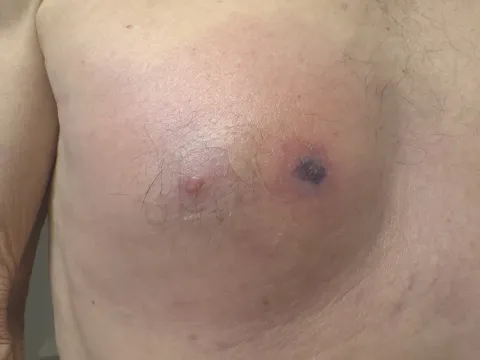 Two days laterDark center, red swelling.
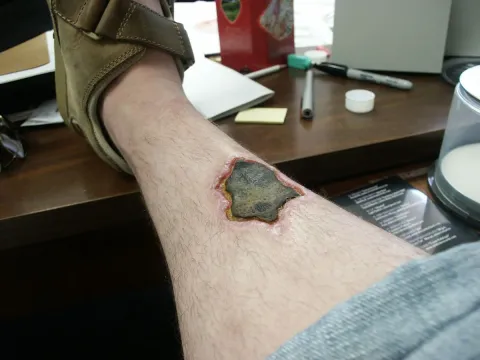 Two months laterDead skin, slow to heal.
The photographers labeled these as brown recluse bites. Infections and other sores can look the same.
Seek emergency treatment right away; call 911 or Poison Control (MedlinePlus). Children may have more serious reactions.
Where you live matters. Brown recluses live in the south-central and Midwestern U.S. and are rare outside that range (University of Kentucky); they don’t live in California (UC IPM). They aren’t aggressive: most bites happen when a spider is trapped against bare skin, such as rolling over one in bed or putting on clothing it was hiding in (University of Kentucky). More on the spider: brown recluse.
Signs It’s Something Else
The University of Kentucky says it’s hard to diagnose a brown recluse bite from the wound alone, and lists conditions that mimic one:
- Bacterial and fungal infections, including drug-resistant staph infections, which have led to several misdiagnoses;
- Diabetic and pressure ulcers, and gangrene.
A spider bite is less likely if:
- you live outside the brown recluse’s range, where surveys rarely find recluses (University of Kentucky);
- a careful search of the house turns up no recluses (University of Kentucky);
- you never saw a spider. Spiders are often blamed for bites of unknown origin, but bites are rare, and spiders bite when crushed or threatened, not by pouncing (University of Kentucky).
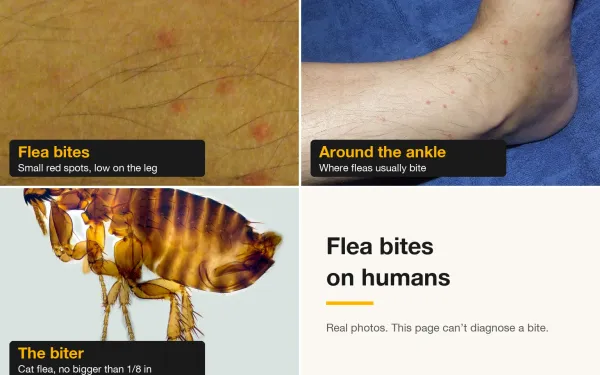
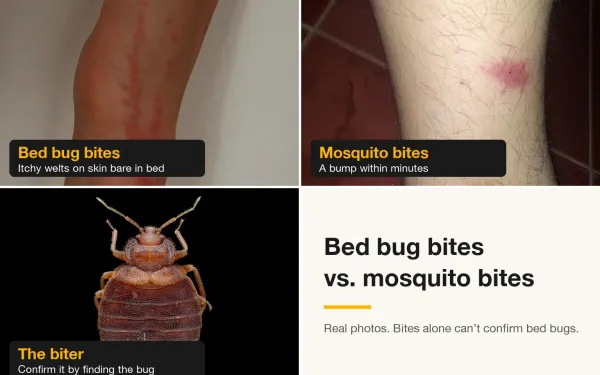
Other biters are more common. Compare bug bite patterns, bed bug bites and flea bites.
Catch the spider if you can. The University of Kentucky says to bring it to a qualified person for identification; even crushed spiders can usually be identified, and that helps your doctor.
How to Treat a Spider Bite
For an ordinary spider bite, MedlinePlus advises:
- Wash the area well with soap and water.
- Apply an ice pack or a wet compress.
- Take an over-the-counter pain medicine if needed, and consider an antihistamine for severe swelling.
- Get medical care for small children, and for adults with severe symptoms.
For a suspected black widow or brown recluse bite, get help first. Until it arrives, MedlinePlus says to clean the bite with soap and water, put ice wrapped in a clean cloth on it for 10 minutes on and 10 off, keep the area still, and loosen clothing and remove rings.
When to Get Medical Help
Call 911 for trouble breathing, wheezing or shortness of breath, swelling anywhere on the face or in the mouth, throat tightness or trouble swallowing, feeling weak, or turning blue (MedlinePlus).
Get medical help right away for:
- a suspected black widow or brown recluse bite (MedlinePlus);
- spreading pain and muscle cramps after a spider bite (MedlinePlus);
- a bite on a small child, or severe symptoms in an adult (MedlinePlus);
- a bite that shows signs of infection over the next several days, such as increasing redness, swelling or pain (MedlinePlus).
The Poison Help line, 1-800-222-1222, reaches your local poison control center from anywhere in the U.S. (MedlinePlus).
Fewer Spiders, Fewer Bites
Where brown recluses live, the University of Kentucky suggests moving beds away from walls, removing bed skirts, and keeping shoes and clothing off the floor or shaking them out first. Sealing cracks and gaps around windows and doors keeps spiders out (UC IPM). The full plan is in how to get rid of spiders.
Common questions
It can happen but it’s uncommon. The University of Kentucky says some people are bitten when they roll over a brown recluse in bed, though it’s common to live in an infested building and never be bitten.
Most aren’t. UC IPM says most spiders can’t harm people and their jaws are too small to bite humans. In the U.S., the black widow and brown recluse are the ones to watch for.
If you can, yes. The University of Kentucky says even a crushed spider can usually be identified, and an expert’s confirmation helps the doctor decide on treatment.
Sources and further reading · 8
- MedlinePlus: Spider Bites: what most bites look like, first aid, when to get care.
- MedlinePlus: Black Widow Spider (Medical Encyclopedia): symptoms, home care, Poison Control.
- MedlinePlus: Brown Recluse Spider (Medical Encyclopedia): symptoms, dead tissue and ulcers, home care, emergency treatment, Poison Help line.
- MedlinePlus: Insect Bites and Stings: when to call 911.
- University of Kentucky: Brown Recluse Spider (EF631): range, how bites happen, misdiagnosis, collecting the spider, reducing bites.
- University of Kentucky: Mystery Bites (EF649): spiders blamed for bites of unknown origin.
- UC IPM: Spiders: most spiders can’t bite people, black widows, brown recluses not in California, sealing gaps.
- Cover photos: black widow by James Gathany, CDC (public domain); brown recluse by CDC (public domain); house spider by Holger Krisp (CC BY 4.0); via Wikimedia Commons.