Rat vs. Mouse: 5 Ways to Tell Them Apart (and Why It Matters)
A mouse is small: an adult house mouse is about 5 to 7 inches long including its 3- to 4-inch tail and weighs about ½ ounce (UC IPM). A Norway rat, the common big rat, can reach 11 inches with a slightly shorter tail, 16 inches in all (Cornell), and weighs 7 to 18 ounces (UC IPM). Beyond size, check five things: the tail, the ears, the snout, the droppings and how the animal behaves around new things. How big rats get, and the world’s biggest, is in how big do rats get.
Cost: about $14–43 in supplies. Difficulty: easy. Call a pro if you can’t tell which one you have after a week of looking, rats are in the walls or attic, or you keep finding fresh droppings after two weeks of trapping.
It matters because the fix is different. Mice and small young rats often won’t set off a rat trap, and mouse snap traps aren’t an effective tool for rats (UC IPM, NC State Extension). Rats also need tougher sealing. This guide covers the five differences, how to tell a young rat from an adult mouse, and what to do once you know. We haven’t trapped and measured rodents ourselves; it rests on UC IPM, Cornell, NC State Extension, University of Kentucky and ICWDM guidance.
Rat vs. Mouse at a Glance
| Feature | House mouse | Norway rat |
|---|---|---|
| Length | 5–7 in including a 3–4 in tail (UC IPM) | Up to 11 in, about 16 in with the tail (Cornell) |
| Weight | About ½ oz (UC IPM) | 7–18 oz (UC IPM) |
| Ears and eyes | Large ears, small black eyes (UC IPM) | Small ears and eyes (Cornell) |
| Snout | Pointier nose (Cornell) | Blunt muzzle (UC IPM) |
| Tail | Thin, almost hairless, about as long as the body | Thick and scaly, shorter than head and body |
| Droppings | ⅛–¼ in, pointed (Cornell) | ¾–1 in, blunt ends (Cornell) |
| Smallest gap | ¼ in tall, ⅜ in wide (UC IPM) | ½ in under a door, for young rats (UC IPM) |
| Litters | 5–10 a year, 5 or 6 pups each (UC IPM) | 4–6 a year, 20 or more young weaned (UC IPM) |
| Around new objects | Inquisitive; investigates them (Univ. of Kentucky) | Avoids them for days or weeks (UC IPM) |
| Water | Gets enough from food (Cornell) | Needs to drink standing water daily (Cornell) |
| Trap | Mouse snap trap, 10 ft apart or less (UC IPM) | Rat snap trap, 10–20 ft apart (UC IPM) |
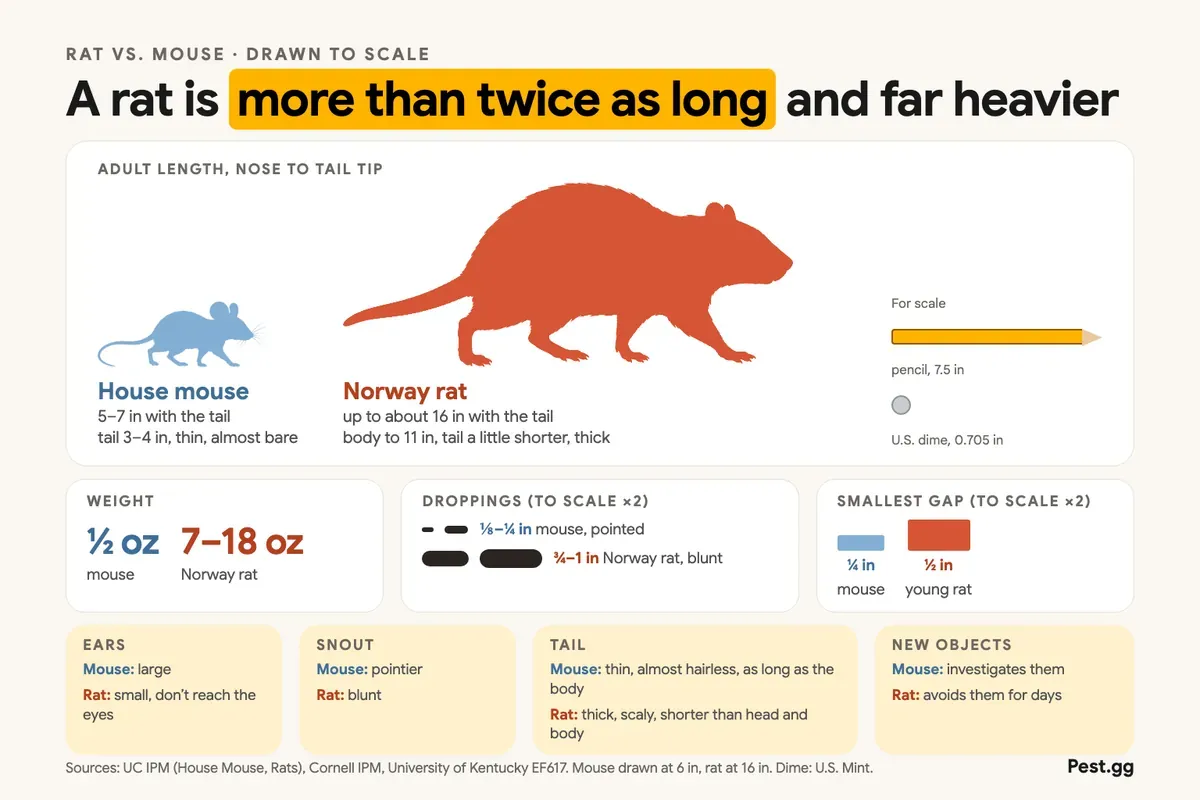
Infographic: a house mouse and a Norway rat to the same scale, with a dime and a pencil. Sources: UC IPM, Cornell, University of Kentucky.
The roof rat, the other common house rat, sits in between: smaller and sleeker than a Norway rat at 5 to 10 ounces, with a pointed muzzle, ears that reach its eyes when folded over and a tail longer than its head and body (UC IPM). See roof rat and Norway rat in the Pest Library.
1. Size and Build
An adult house mouse fits in your palm: about 5 to 7 inches nose to tail tip, more than half of that tail, and about ½ ounce (UC IPM). An adult Norway rat is several times heavier, 7 to 18 ounces (UC IPM), and generally larger and stockier than the roof rat (UC IPM).
Size alone can fool you, though. A young rat can be about as long as a big mouse; the next section shows how to tell them apart.
2. Tail
A house mouse’s tail is thin and has almost no fur on it (UC IPM), and it is about as long as the body (Cornell). A Norway rat’s tail is thick, scaly, dark on top and pale below, and shorter than its head and body: pulled forward over the back, it reaches only about the middle of the skull (UC IPM).
3. Ears, Eyes and Snout
Mice have relatively large ears and small black eyes (UC IPM), and compared with young rats, a pointier nose (Cornell). Norway rats have small ears and eyes and a blunt muzzle; folded forward, their ears don’t reach the eyes (UC IPM, Cornell).
4. Droppings
Mouse droppings are ⅛ to ¼ inch long; Norway rat droppings are ¾ to 1 inch (Cornell). Rats leave theirs in small clumps, about 40 to 50 a day (ICWDM), while mouse droppings are scattered along their trail. Don’t decide from one pellet: a big mouse and a young rat can leave droppings of similar size. Mouse poop vs. rat poop compares them side by side, roof rats included.
5. Behavior
Mice are curious. The University of Kentucky says they investigate each new object placed in their foraging area, which is why a mouse can turn up in a new trap the first night. They also stay close to home: UC IPM says house mice seldom go more than 30 feet from their nest and food.
Rats are wary. They quickly detect and avoid new objects and new foods, and often avoid traps and baits for the first several days, maybe weeks (UC IPM). NC State Extension says traps may take up to a week to catch anything. Rats also forage farther from the nest than mice do (University of Kentucky), and unlike mice they need to drink standing water every day (Cornell).
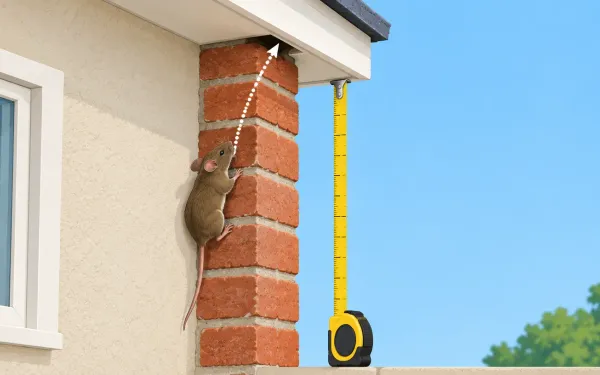
Both are mostly active at night; see are mice nocturnal. Mice are better at getting into small places: they squeeze under gaps ¼ inch tall (UC IPM) and climb rough walls.
Young Rat vs. Adult Mouse: Look at the Head and Feet
This is the hard case, because a young rat can be the same length as a mouse. UC IPM’s rule: very young rats have large heads and feet in proportion to their bodies, while an adult mouse’s head and feet are much smaller for its size.
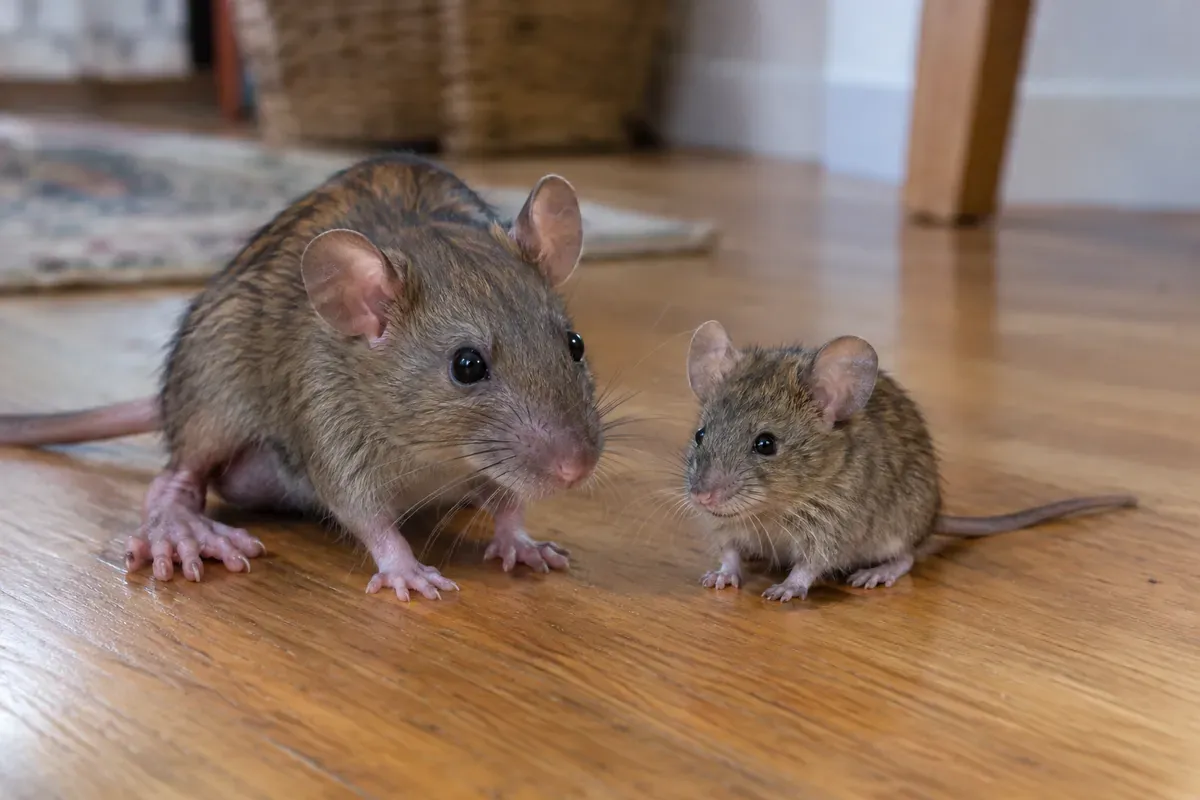
Illustration: a young rat (left) has a big head and big feet for its size; an adult mouse (right) has small ones and bigger ears.
Other clues help. Droppings of very different sizes in the same spot can mean young and adult rats together (Cornell). And if the “mouse” keeps avoiding your traps for days, consider that it may be a rat.
Why It Matters: Different Traps, Bait and Sealing
Traps. Use the trap made for the animal. UC IPM warns that mice and small young rats often won’t trigger a rat snap trap, and NC State Extension says mouse snap traps aren’t effective for rats.
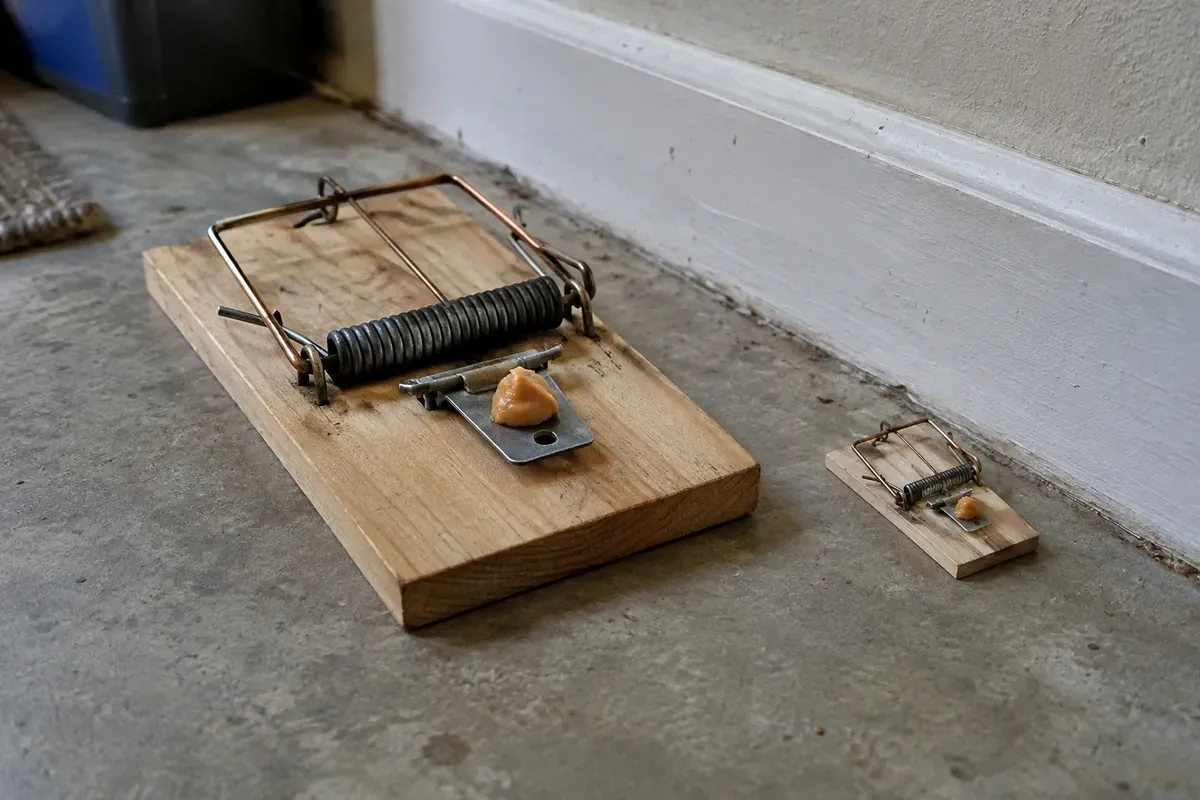
Illustration: a rat snap trap (left) next to a mouse snap trap (right).
| Step | Mice | Rats |
|---|---|---|
| Trap spacing | No more than about 10 ft apart, against walls; pairs 1–2 in apart catch more (UC IPM) | About 10 to 20 ft apart (UC IPM) |
| Bait | What they’re already eating; peanut butter works; cotton or floss as nesting bait (UC IPM) | A pea-sized amount (UC IPM) |
| First nights | Set the traps right away; mice investigate new objects (Univ. of Kentucky) | Leave traps baited but unset until the bait has been taken several times (UC IPM) |
| Seal | Gaps ¼ in and up, with coarse steel wool, wire screen, metal or concrete (UC IPM) | Holes over ¼ in, with steel wool, wire screen or sheet metal; ½-in galvanized mesh on vents (UC IPM) |
| Don’t use | Foam, plastic, rubber or wood to seal (UC IPM) | Plastic, foam, wood or caulk alone, and chicken wire (UC IPM) |
Sealing. UC IPM says all holes larger than ¼ inch should be sealed to keep out both rats and mice. Rats chew through plastic, foam, wood and caulk, so use steel wool, wire screen or sheet metal, and 18-gauge, ½-inch galvanized mesh on vents rather than chicken wire. Steel wool vs. copper mesh compares the fillers.
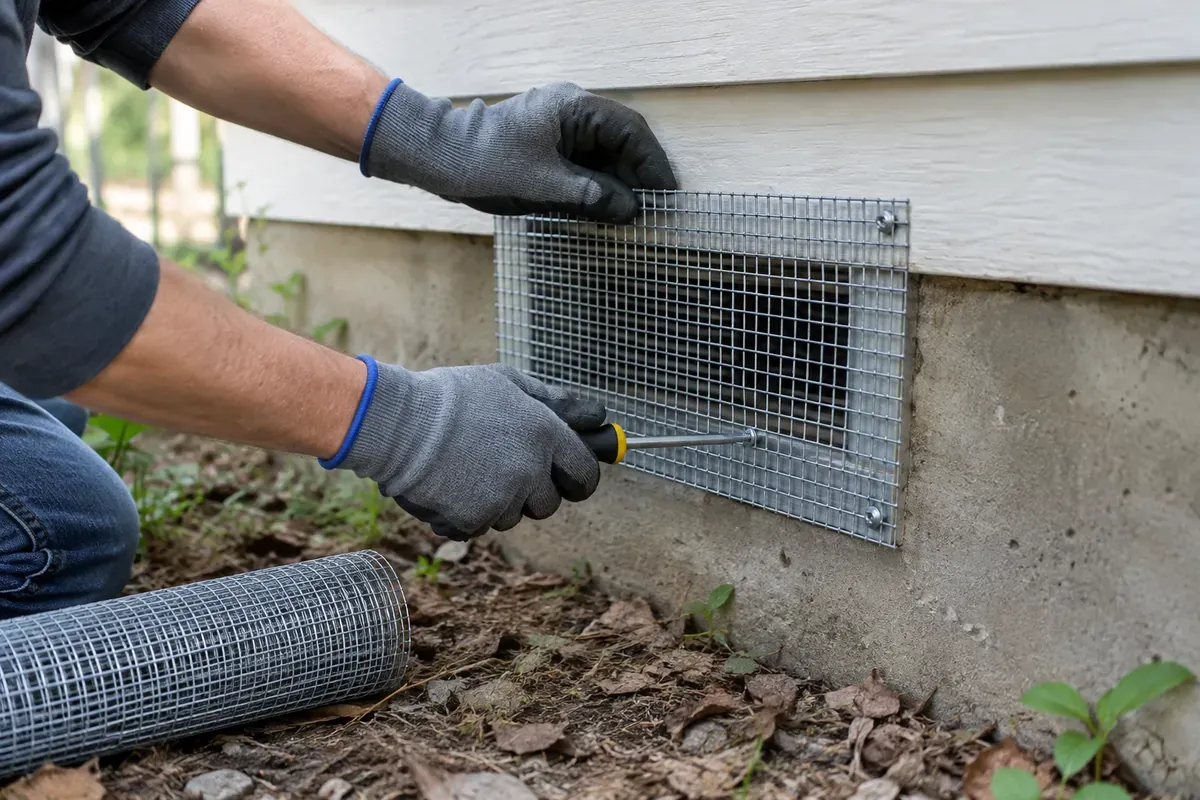
Illustration: galvanized ½-inch mesh going over a foundation vent, the kind of sealing UC IPM recommends for rats.
What It Costs
| Item | Typical cost |
|---|---|
| 12 wooden mouse snap traps | $13.74 |
| Wooden rat snap trap | $3.59 each |
| 6–12 rat snap traps | $22–43 |
U.S. list prices, September 30 to October 1, 2026, before tax. Mice: about $14 for a dozen traps. Rats: $22–43 for 6 to 12 traps. Steel wool, mesh and caulk for sealing are extra; what an exterminator costs vs. DIY prices a full kit.
What to Do Next
- Measure a few droppings and check where they are.
- Mouse-sized? Follow how to get rid of mice.
- Rat-sized, or traps ignored for days? Follow how to get rid of rats in your house.
- Seal gaps larger than ¼ inch with metal, whichever you have.
- Clean up wet, never by sweeping or vacuuming; see how to clean mouse droppings.
When to Call a Pro
If you can’t tell which one you have after a week of looking, rats are in the walls or attic, or you keep finding fresh droppings after two weeks of trapping.
Common questions
Think about size and the tail. A small animal with big ears and a thin tail that vanished into a tiny gap is likely a mouse. A heavy-bodied animal with a thick tail is likely a rat. Then check the droppings to confirm.
Two common reasons. If it’s actually a mouse or a small young rat, it may not be heavy enough to set off a rat trap (UC IPM). If it’s a rat, it may be avoiding the new trap: rats can shun traps for the first several days or longer, so leave them baited but unset until the bait has been taken a few times (UC IPM).
Each is harder in its own way. Rats chew through plastic, foam, wood and caulk (UC IPM), so they take tougher sealing, and they avoid new traps for days. Mice get through smaller gaps, ¼ inch versus ½ inch, and breed faster, with 5 to 10 litters a year against a Norway rat’s 4 to 6 (UC IPM). Both leave droppings and urine that need a wet cleanup with gloves.
By length: mouse droppings are ⅛ to ¼ inch, Norway rat droppings ¾ to 1 inch (Cornell). Look at several, not one. See mouse poop vs. rat poop.
The Bottom Line
A mouse is small, big-eared and thin-tailed, with rice-sized droppings; a rat is heavy, small-eared and thick-tailed, with droppings ¾ inch or longer. A young rat gives itself away by its big head and feet. Use mouse traps for mice and rat traps for rats, and seal every hole over ¼ inch with metal.
Sources and further reading · 7
- UC IPM: House Mouse: mouse length, weight, ears, tail, gaps, litters, range, traps, bait and sealing.
- UC IPM: Rats: rat weight, tail, ears, muzzle, litters, ½-inch gaps, wariness of new objects, trap spacing, bait amount and sealing materials.
- UC IPM: Rats (Pest Notes 74106): young rats vs. mice; mice and small rats won’t trigger rat traps.
- Cornell IPM: Mouse and Rat Biology and Behavior: body lengths, ears, droppings, water needs.
- NC State Extension: Surveillance and Management of Common Structure-Invading Rats: mouse traps aren’t effective for rats; traps may take a week.
- University of Kentucky: Control of Mice (EF617): mice investigate new objects.
- ICWDM: Norway Rats: droppings per day.