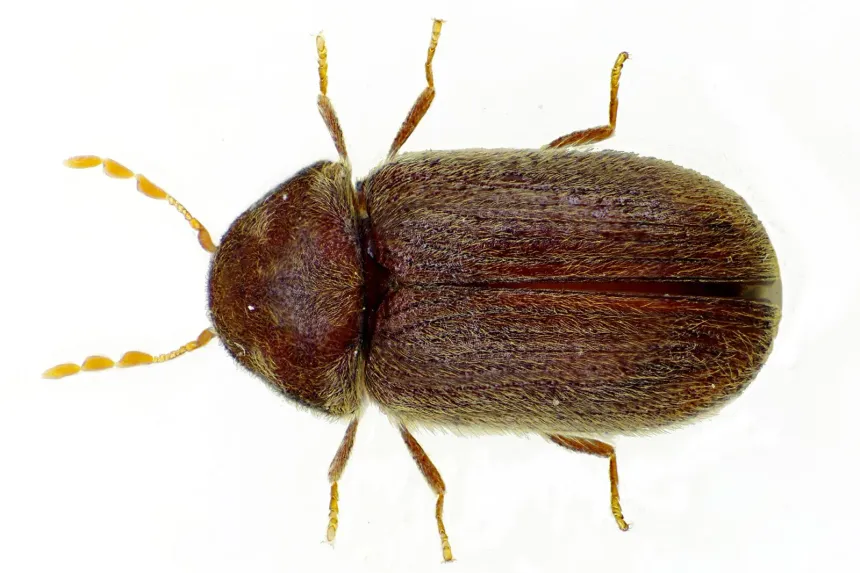
- Scientific name
- Stegobium paniceum
- Also called
- bread beetle, biscuit beetle
- Size
- About 1/10 in
- Color
- Reddish brown
- Found in
- Spices, flour, baking mixes, pet food, dried herbs, even books
- Harmful?
- Spoils food; not a health risk
- Active
- Year-round indoors; adults fly to windows
What to do
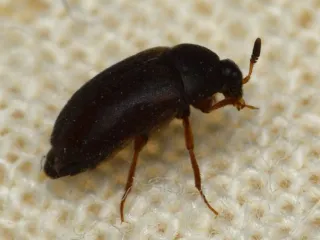
The drugstore beetle is a tiny reddish-brown beetle that infests almost any dry food: spices, flour, pet food, dried flowers. It got its name from dried medicinal herbs in old pharmacies, and UC IPM quotes the saying that it will “eat anything except cast iron.” It doesn’t bite. The one thing to do: find the infested package, often old spices or pet food at the back of a shelf, and throw it out. The full cleanout is in how to get rid of drugstore beetles.
Below: how to identify the adult and the larva, tell it from look-alikes, and find and clear the source.
How to Identify a Drugstore Beetle: Tiny, Reddish, Head Tucked Under
- Tiny: about 1/10 inch, oval and reddish brown.
- Head tucked under so it’s hard to see from above.
- Fine rows of grooves along the wing covers, visible with a magnifier.
- Antennae end in a three-part club.
- Adults fly toward light, so they often show up on windowsills near the kitchen.
Not sure it’s a drugstore beetle? Identify it from a photo.
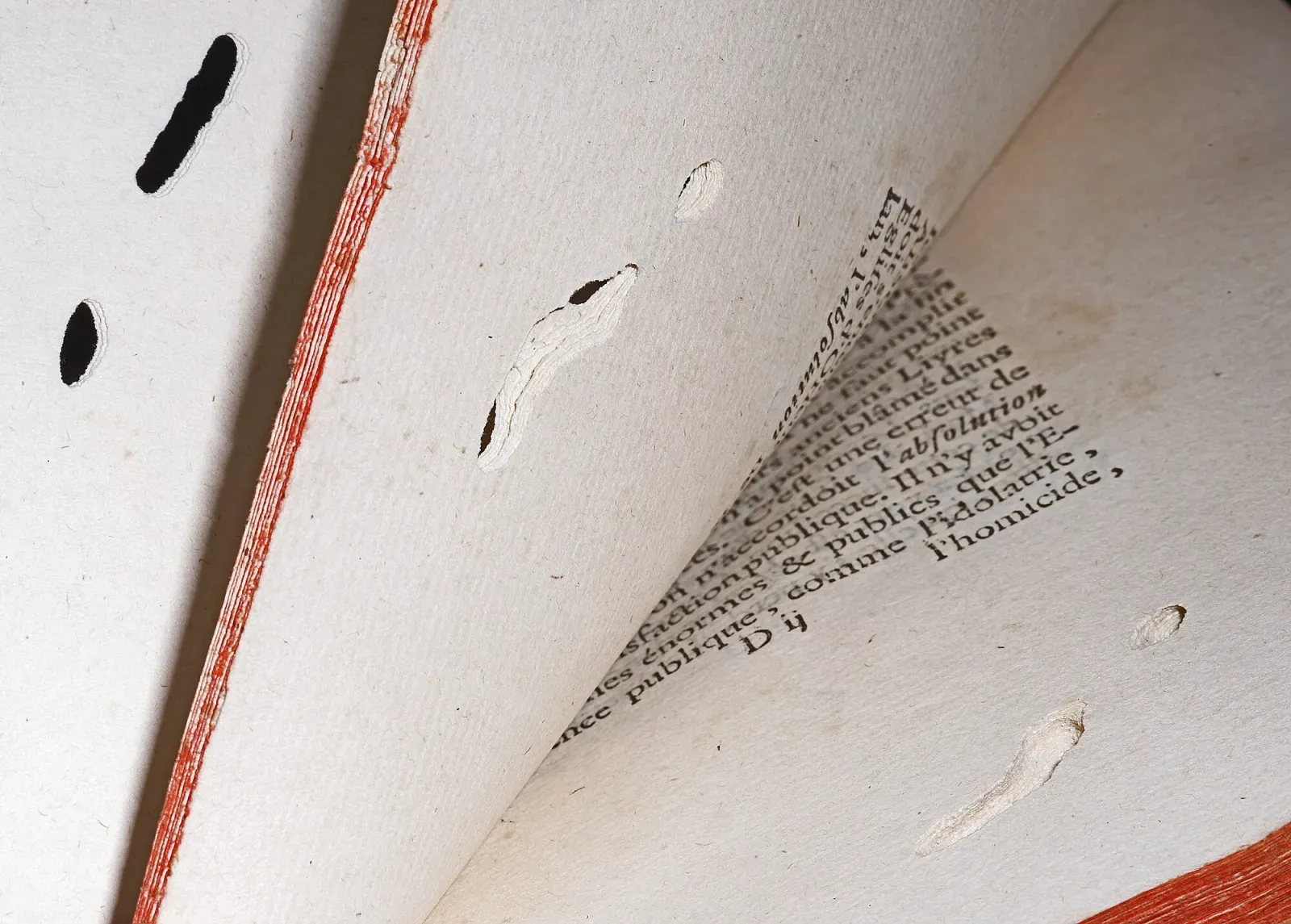
Tunnels chewed through an old book by drugstore beetle larvae. Photo: Didier Descouens (CC BY-SA 3.0), via Wikimedia Commons.
Not sure this is your bug? Upload a photo to our free bug identifier.
Drugstore Beetle Life Cycle and Larvae
Females lay eggs one at a time in almost any dry food, and the eggs hatch in about 6 to 10 days (Penn State). The larvae are white, C-shaped grubs up to about 3/16 inch (Texas A&M). Newly hatched larvae are active enough to get into packages through tiny gaps, even the seams around spice lids (Texas A&M). They pupate in a small cocoon in the food, and the whole cycle takes about 40 to 75 days depending on conditions (Penn State, Clemson). Adults fly and are drawn to light (Clemson).
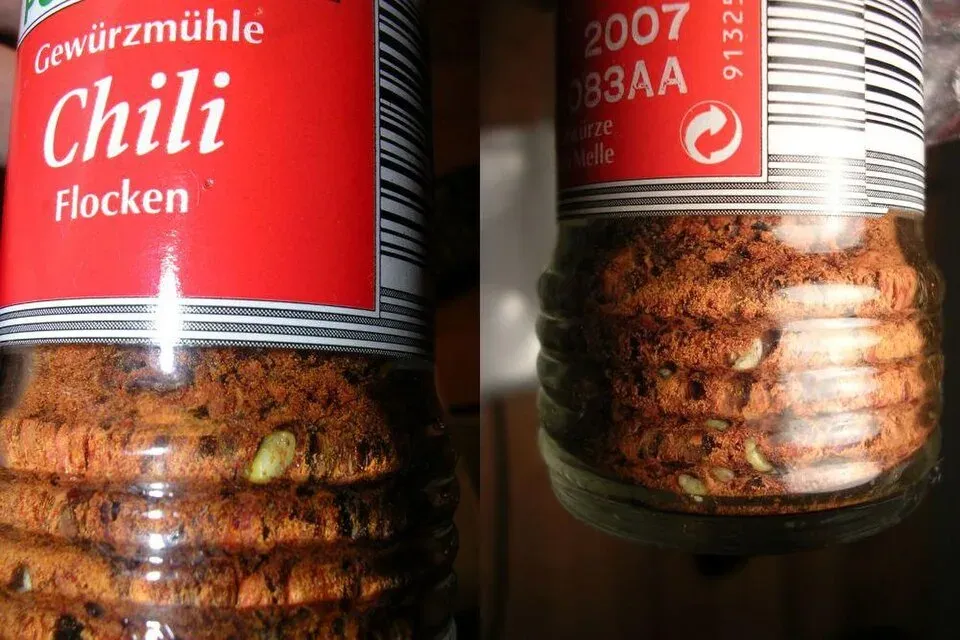
Drugstore beetle grubs, the white specks, in a jar of chili flakes. Photo: Uwe1975 (public domain), via Wikimedia Commons.
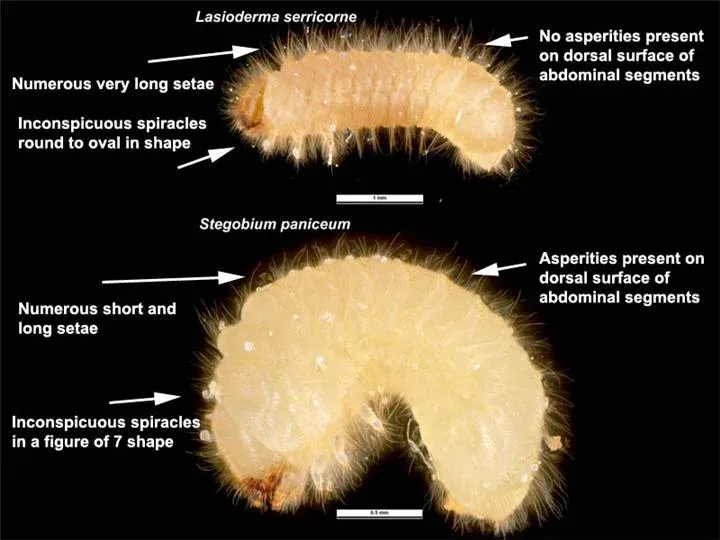
Cigarette beetle larva (top) and drugstore beetle larva (bottom). Texas A&M notes the cigarette beetle larva’s hairs are longer and more obvious. Photo: Simon Hinkley & Ken Walker, Museum Victoria (CC BY 3.0), via Wikimedia Commons.
Drugstore Beetle vs. Look-Alikes: Grooves and Snout
| Beetle | How it differs | How to tell |
|---|---|---|
| Drugstore beetle | Reddish brown, grooved wing covers | Head tucked under |
| Cigarette beetle | Almost identical, more common | Smooth wing covers, saw-toothed antennae, more humped |
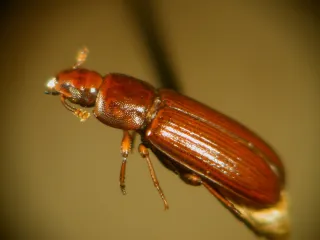
| Red flour beetle | Longer, flat, shiny | Head visible from above; in flour |
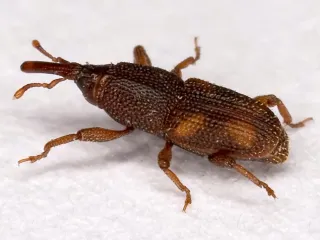
| Rice weevil | Similar size | Long snout; inside whole grains |
Drugstore and cigarette beetles infest the same foods and are handled the same way; the cigarette beetle also eats cured tobacco (UC IPM).
Where You’ll Find Them: Any Dry Food
- Spices (especially paprika and chili powder), flour and baking mixes
- Dry pet food, birdseed and dried flowers
- Cereal, crackers, pasta and tea
- Windowsills near the kitchen
Females lay eggs in almost any dry organic material.
Are Drugstore Beetles Harmful? They Spoil Food
They don’t bite or spread disease. They spoil food, leave tiny holes in packages and spread to other dry goods. Their larvae are among the small grubs shown in bug eggs and larvae.
How to Confirm It’s a Drugstore Beetle
- Check spices and pet food first for tiny holes and live beetles.
- Look with a magnifier for grooves on the wing covers.
- Watch the window: small reddish beetles flying to light near the kitchen.
- Hang a pheromone trap. Traps baited with the beetles’ sex scent catch adult males and work better near a window or other light (Texas A&M). Alabama Extension suggests them for checking that an infestation is really gone, and for catching beetles brought in with new food.
How to Get Rid of Drugstore Beetles
Use the same cleanout as for pantry moths:
- Find every infested package, often old spices, pet food, flour or dried flowers at the back of a shelf, and throw it out.
- Freeze anything you want to keep at 0°F for 4 days (University of Kentucky).
- Vacuum and wash the shelves.
- Store dry food in jars with tight lids. UC IPM says plastic bags aren’t adequate, and keeping rarely used flour, spices and grains in the freezer prevents infestations.
UC IPM doesn’t recommend insecticides for pantry pests, so you don’t need to spray. The step-by-step version, with costs, is how to get rid of drugstore beetles.
Why Are Tiny Wasps Showing Up?
They’re probably parasitoid wasps feeding on the beetle larvae. Researchers found that one lineage of the wasp Lariophagus distinguendus is apparently specialized on drugstore beetles in households (König et al. 2019). Parasitoid wasps don’t sting or bite people (University of Minnesota Extension). Their arrival means beetle larvae are still breeding somewhere, so find and throw out the infested food.
For other pests, browse all pest guides.
Often confused with
Sources
- Stored Product Pests in the Pantry (University of Kentucky Entomology, EF612)
- Pantry Pests (UC IPM)
- Drugstore Beetle (Penn State Extension)
- Cigarette and Drugstore Beetles (Texas A&M AgriLife Extension, ENT-2004)
- Drugstore Beetles (Clemson Cooperative Extension, HGIC)
- What Are the Small Brown Beetles in My Home? Drugstore Beetles (Alabama Cooperative Extension System)
- Parasitoid Wasps (University of Minnesota Extension)
- König et al. 2019, Molecular and Cytogenetic Differentiation Within the Lariophagus distinguendus Species Complex (Comparative Cytogenetics)
Last reviewed Nov 23, 2026.