Mouse Urine Smell: How to Find It and Get Rid of It
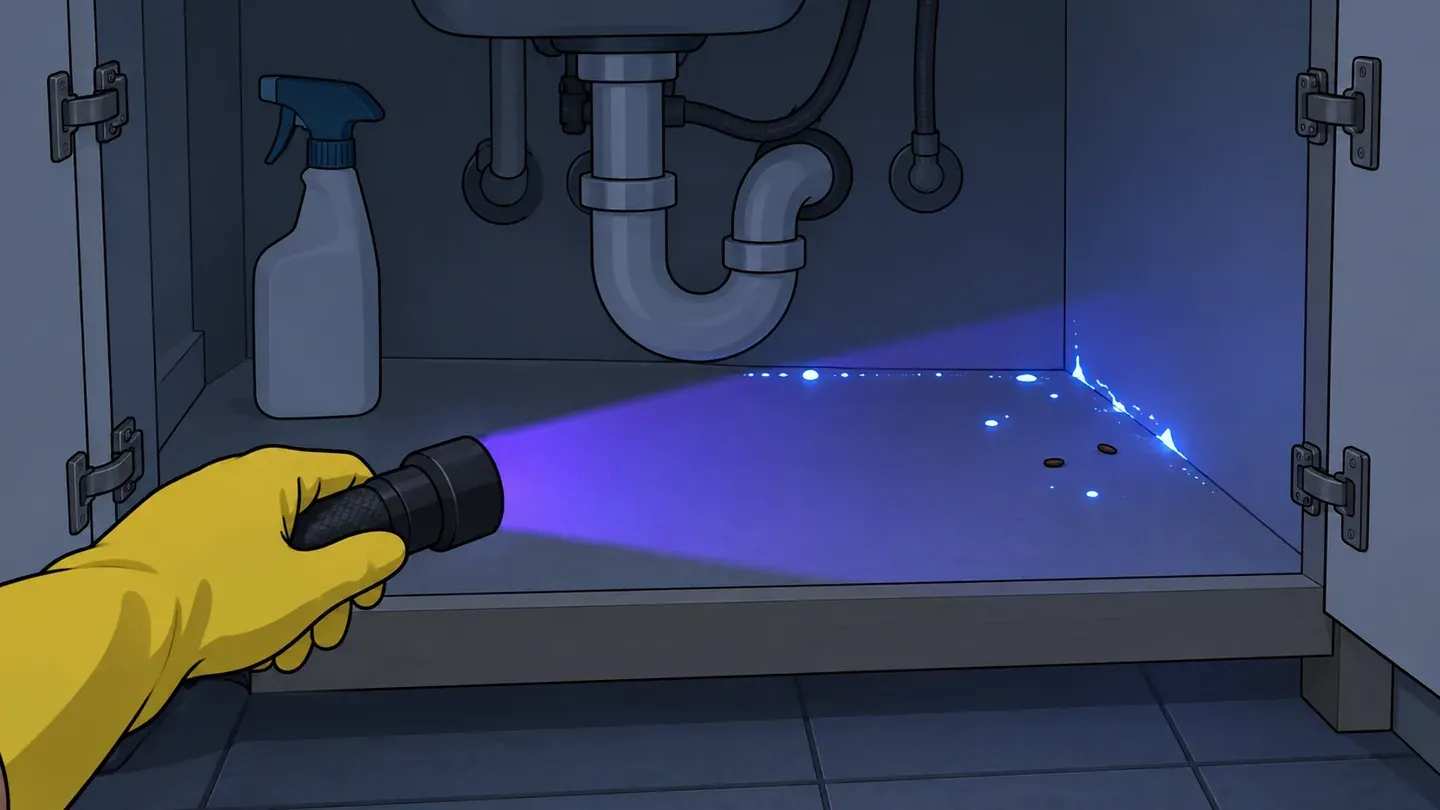
Illustration: under a UV light, fresh rodent urine glows blue-white, but so do many other things.
Mouse urine smell is musky and ammonia-like, especially in cabinets, drawers and along baseboards. Find the source there and near nests. Air out the room, spray spots with disinfectant or bleach solution, soak 5 minutes and wipe up; never sweep or vacuum (CDC).
Cost: about $15–21 in supplies. Difficulty: easy. Call a pro if urine and droppings cover a large area, mice have been in your heating or cooling ducts, or fresh urine spots keep appearing after a week of trapping.
We haven’t tested products ourselves; this guide rests on CDC, university extension and National Park Service (NPS) guidance.
Mouse Urine, Rat Urine or a Dead Mouse?
| What you notice | Likely cause |
|---|---|
| Musky, ammonia-like odor that builds over weeks, often with fresh droppings | Living mice: urine, droppings and nests |
| Musty smell from a heavy infestation | Rats (NC State Extension) |
| Rotten smell, sometimes with flies, often after using poison | A dead rodent in a wall, ceiling or floor |
A rotten smell usually points to a dead mouse, which needs a different fix: poisoned rodents often die out of reach and draw flies. Large droppings? See rat poop vs. mouse poop.
What Does Mouse Urine Smell Like?
Musky and ammonia-like. The University of Arizona Extension describes a “musky ammonia smell” most noticeable in pantries, cabinets and drawers, often stronger along baseboards. Because it is common in large or long-term infestations, a strong mouse urine odor usually means an established problem, not one stray mouse.
The odor builds up where mice spend time: the NPS says nests and travel routes can often be smelled because urine and droppings collect there.
What Does Mouse Urine Look Like?
Mouse urine is hard to spot. The Internet Center for Wildlife Damage Management (ICWDM) says to look for tiny droplets, from a couple of millimeters across to microscopic, where mice travel or feed. Rodents urinate while running, so a mouse urine trail often leaves streaks along a wall or shelf edge.
Where it builds up, look for dark spatters on floors and shelves, stains on fabric and ceiling tiles, and greasy smears on walls, pipes and wires. A stained ceiling tile far from any water source points to rodents, not a leak.
Droppings are the easier clue: mouse droppings are ⅛ to ¼ inch (3–6 mm) long (NPS), and they usually sit near mouse pee stains.
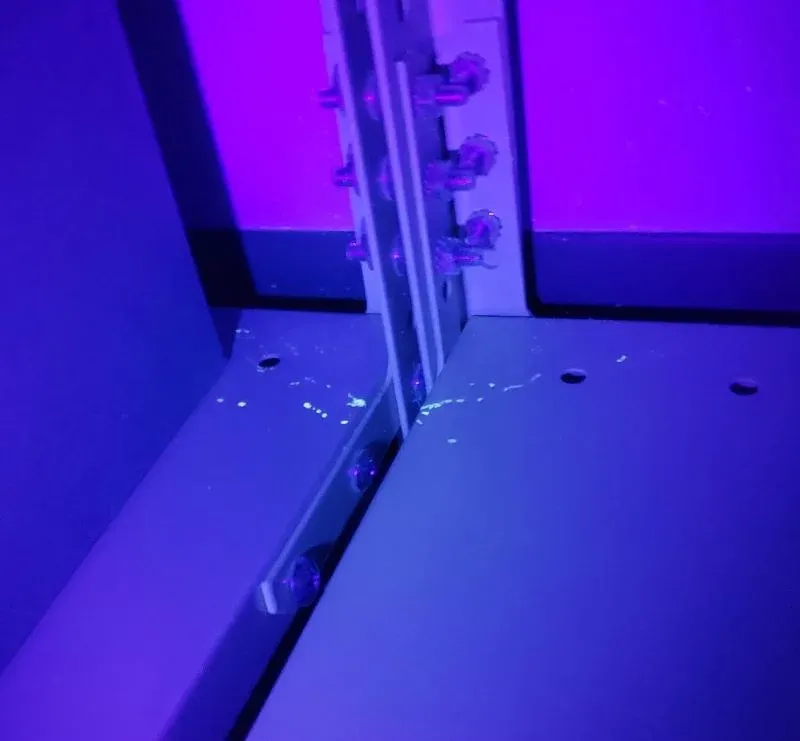
Real photo: mouse urine glowing under a UV flashlight on a cabinet shelf. Photo: National Park Service (Conserve O Gram 3/12), public domain.
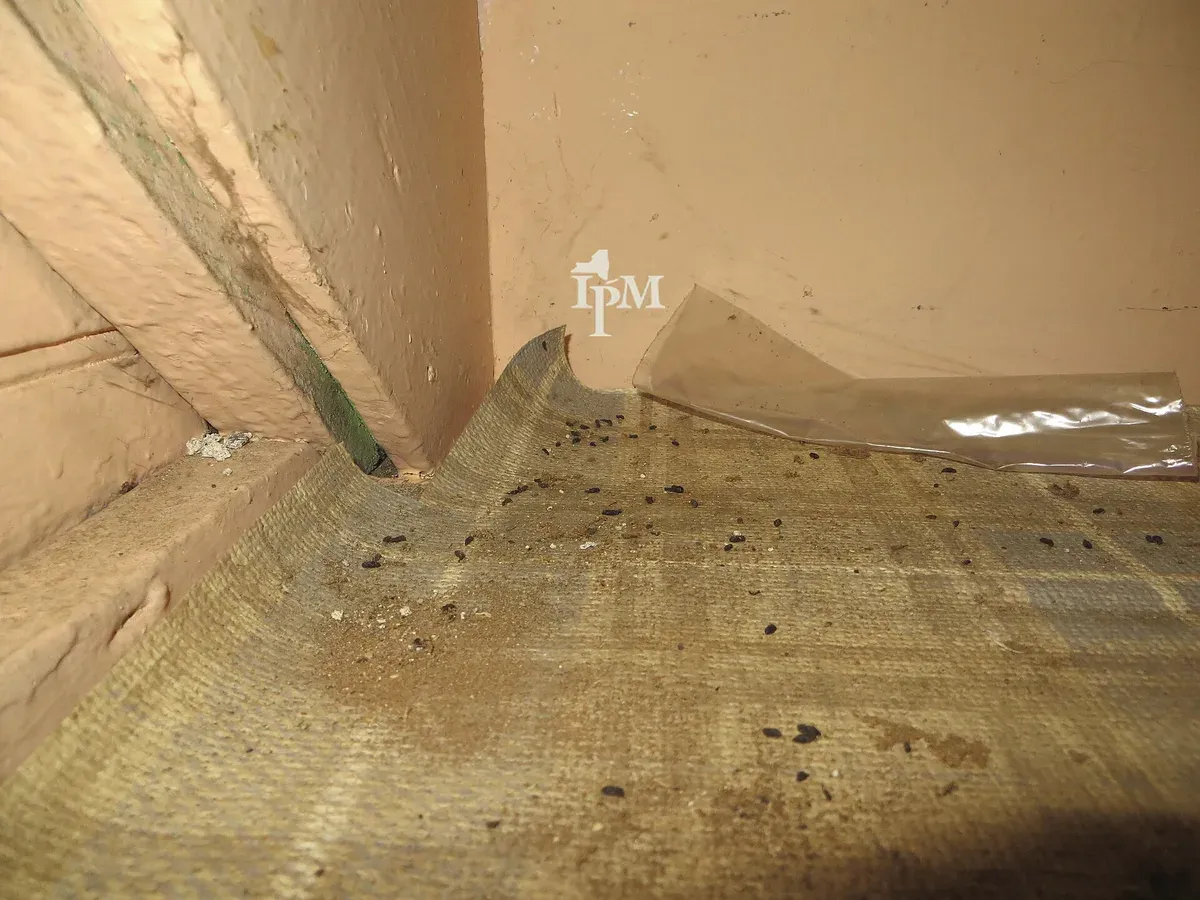
Real house mouse droppings along a wall. Photo: Matt Frye, NY State IPM Program at Cornell University (CC BY 2.0), via Wikimedia Commons.
How to Confirm the Source of the Smell
Step 1: Follow the smell to the strongest spot. Check cabinets, closets and drawers first, without touching anything.
Step 2: Check the closed-in spots behind the stove and refrigerator and in the back of cabinets and drawers.
Step 3: Look for nests near heat. Nebraska Extension says mouse nests are often near water heaters, ovens and refrigerators.
Step 4: Confirm with droppings, gnaw marks or smears. Smell alone doesn’t show where the mice are now.
UV lights: a hint, not proof. Fresh rodent urine glows blue-white under ultraviolet (black) light, wet or dry, but so do many cleaning products. A Utah State University Extension manual says spotting urine this way “takes skill” and doesn’t recommend UV lights, because droppings are easier to find. The NPS uses them only where other signs exist.
Cleaning Mouse Urine: Soak 5 Minutes, Never Sweep
Soak, wait and wipe, not sweep or vacuum: the CDC says sweeping or vacuuming rodent urine, droppings or nests can put tiny droplets containing viruses into the air. Never mix bleach with ammonia or any other cleaner.
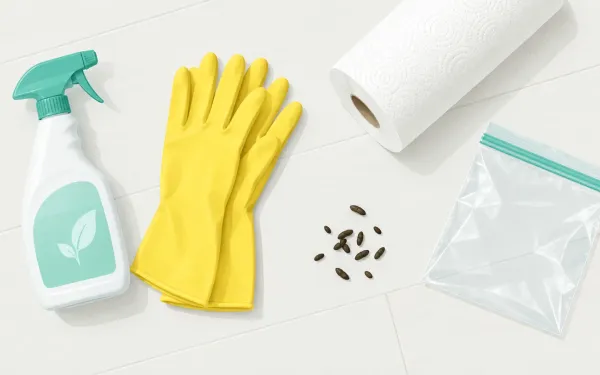
Air out the room for 30 minutes and put on rubber or plastic gloves. Spray the spots until very wet with a household disinfectant (the label must say “disinfectant”) or fresh bleach solution, 1 part bleach to 9 parts water. Let it soak 5 minutes or as long as the label says, wipe up with paper towels, throw them in a covered garbage can and wash your hands.
Droppings or nests too? Follow cleaning up mouse droppings. For a heavy infestation, the CDC calls for coveralls, goggles and a half-mask respirator with HEPA filters.
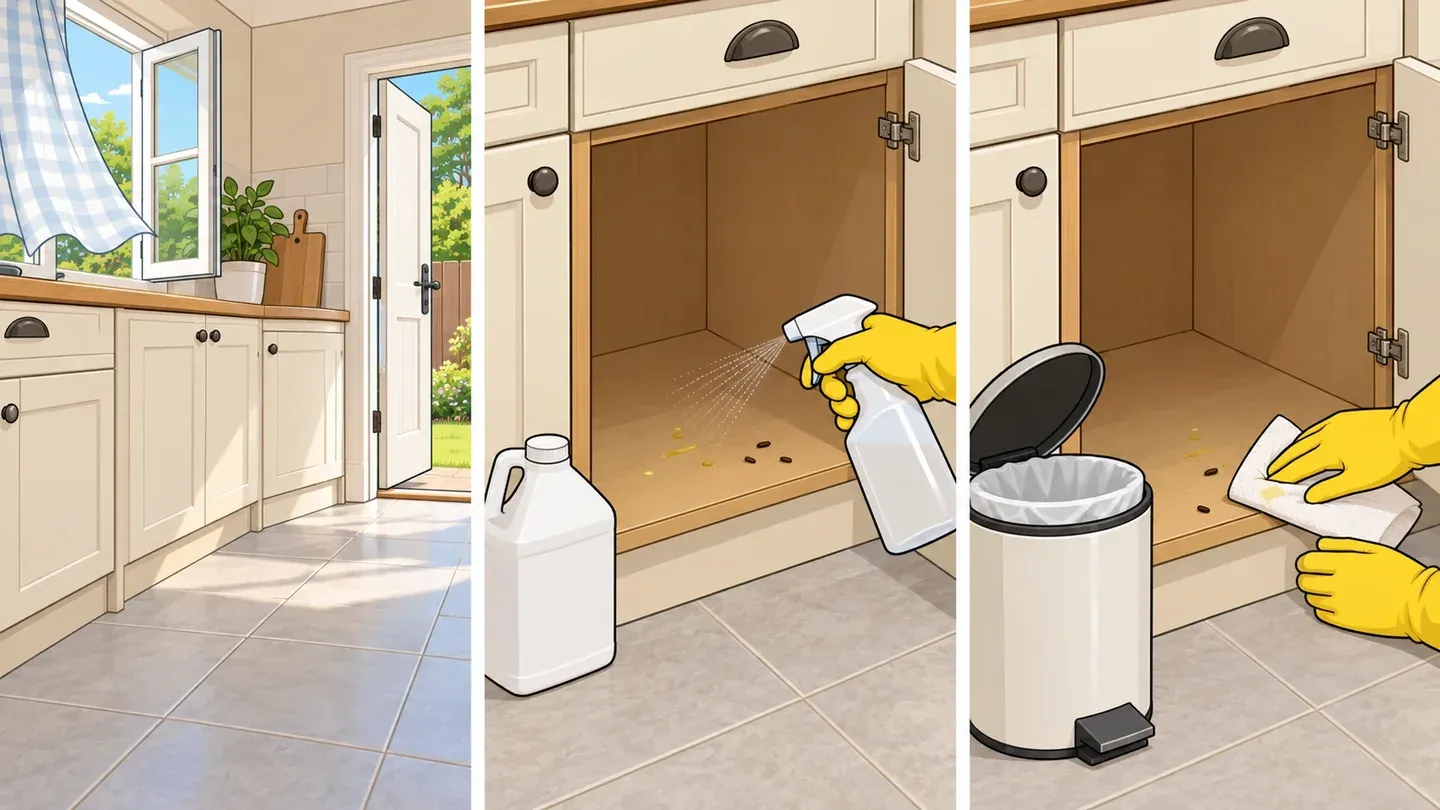
Illustration: a window and door propped open, a gloved hand spraying urine spots on a cabinet floor, and paper towels wiping them up.
How to Get Rid of Mouse Urine Smell in Carpet, Fabric and Wood
Disinfect first, then treat the odor. These CDC steps for other materials come after the soak-and-wipe above:
| Material | What to do |
|---|---|
| Clothing and bedding | Hot wash with detergent, then dry on high or in the sun |
| Carpets and upholstery | Shampoo with a commercial disinfectant, or a commercial-grade steam cleaner |
| Books and papers | Sunlight for several hours, or a rodent-free room for at least three weeks, preferably six |
| Cardboard | Throw out boxes soiled with urine or droppings |
| Attic insulation | Bag soiled insulation for removal; see mice in the attic |
| Cars | Open doors, hood and trunk for 20 minutes; disinfect before any vacuuming; replace the air filter if mice nested in the intake |
If carpet still smells, Ohio State’s veterinary college (writing about cat urine) says to replace the pad; on wood, sand and refinish if an enzymatic cleaner isn’t enough. Smell coming from inside a sofa? Check the couch for a nest.
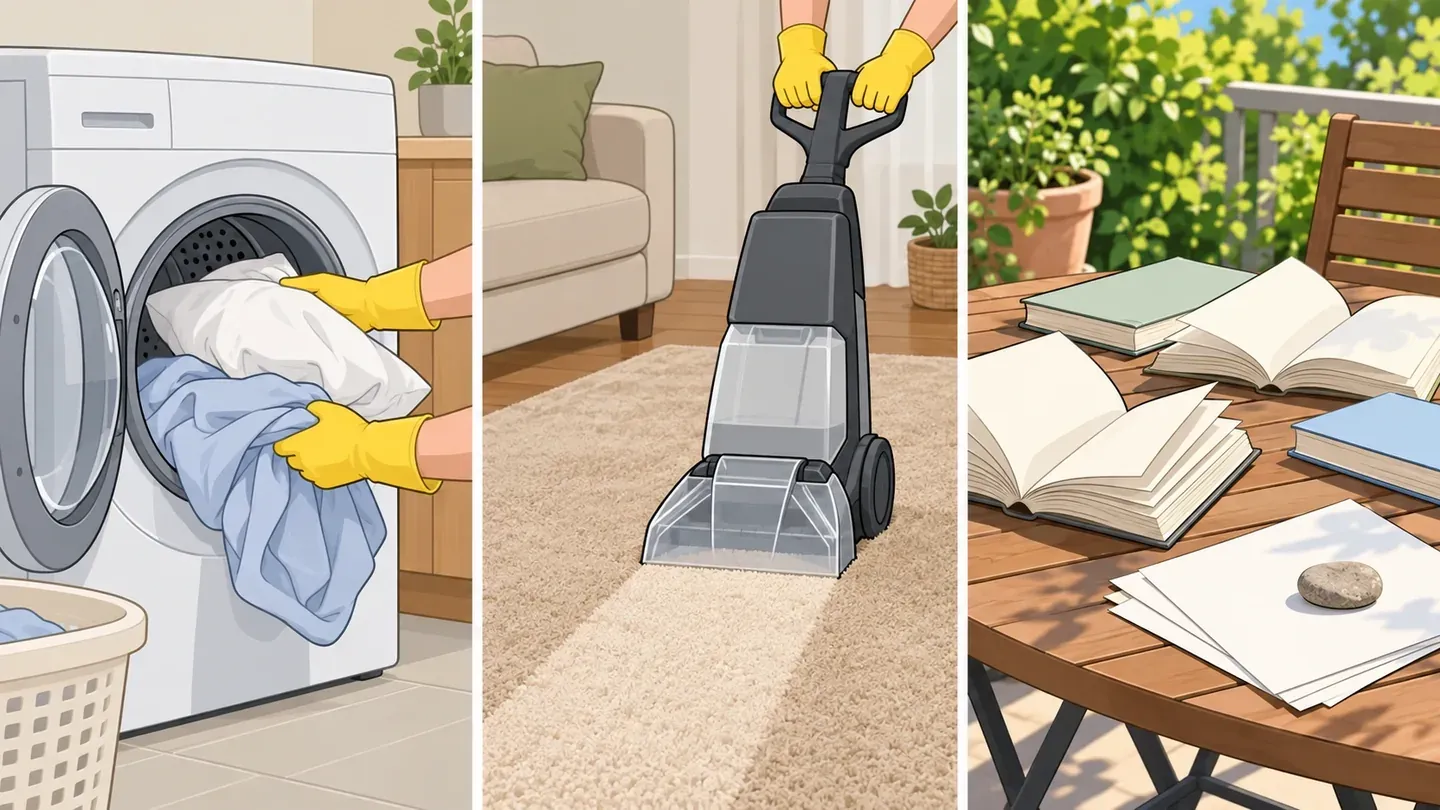
Illustration: bedding going into a washing machine, a rug being shampooed, and books laid open in the sun.
Which Mouse Urine Odor Remover Works?
Disinfect first, then deal with the smell. What each product can and can’t do:
| Product | What it does | Use it for | Watch out |
|---|---|---|---|
| Disinfectant or bleach solution (1:9) | Kills germs in urine and droppings (CDC) | Every spot, first | Never mix bleach with ammonia or any other cleaner (CDC) |
| Enzymatic cleaner | Breaks down urine odor (Humane World for Animals, Ohio State) | Carpet, fabric and wood, after disinfecting and once dry | Not a disinfectant; the one priced below isn’t labeled as one. Never use with bleach |
| Baking soda in the wash | Added to detergent for soiled fabric (Humane World for Animals) | Bedding and washable rugs | Still smells? Wash again with an enzymatic cleaner |
| Steam cleaner | Heat can set urine odor into synthetic fibers (Humane World for Animals) | Skip for urine | Shampoo with a disinfectant instead |
| Ozone generator | At safe levels, ozone doesn’t remove many odor-causing chemicals (EPA) | Not for rooms people or pets use | High levels can harm people and pets and damage rubber, wire coatings and fabrics (EPA) |
Still smells after all that? See why it can still smell after cleaning.
Is Mouse Urine Dangerous?
It can be: the CDC says rodent diseases mainly spread when people breathe contaminated air.
- Hantavirus: can get into the air when fresh urine, droppings or nests from an infected rodent are stirred up. In the U.S., the most common hantavirus that causes illness is spread by the deer mouse. House mice aren’t known carriers, though few people can tell the species apart.
- Lymphocytic choriomeningitis (LCM): spread by the house mouse through fresh urine, droppings, saliva or nesting material; it can be serious for pregnant women and people with weakened immune systems.
- Leptospirosis: spread through the urine of infected animals, including rats and mice.
- Asthma and allergies: UC IPM says house mouse urine is a major source of allergens, linked to early asthma in sensitive children.
If you get sick after contact with mice or rats, see a doctor and mention the rodent exposure. If you’re pregnant, the CDC’s LCM advice is to avoid contact with wild mice, so ask someone else to clean up.
Why Does It Still Smell After Cleaning?
Either urine soaked into something porous, or mice are still marking their routes. Trap with snap traps near the urine and droppings, not glue or live traps, which the CDC says scare rodents into urinating; see how to set a mouse trap. Seal gaps as wide as a pencil (¼ inch, 6 mm) with steel wool and caulk.
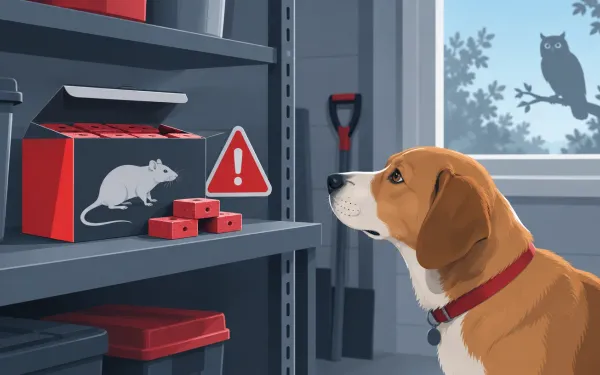
Skip poison indoors: poisoned mice often die inside the house, adding a second smell (rat and mouse poison dangers). When a week passes with no catches and no new signs, they’re gone; if new urine spots keep appearing after that, the CDC says you may have rats (getting rid of rats). The full plan is in how to get rid of mice.
What It Costs: DIY vs. a Pro
| Item | Typical cost |
|---|---|
| Nitrile gloves (50) and bleach (81 oz) | $14.88 |
| Enzymatic odor cleaner, 32 oz (optional) | $5.99 |
| UV flashlight (optional) | From $24.70 |
| Pro trap-and-seal job, 223 shared quotes (middle half) | $1,000–$3,500 |
| Pro visit, price-guide range (usually no sealing) | $150–$656 |
| Pro attic insulation cleanup, if upsold | $6,000–$12,800 |
DIY: Target list prices on September 30 and October 1, 2026, before tax. Pro: the middle half of 223 trap-and-seal quotes homeowners shared on Reddit, 2020–2026 (see the quote table). Price-guide range: This Old House for mice (April 2026) and HomeAdvisor for rats (June 2026); it usually covers a trap-and-bait visit, with sealing extra. Attic cleanup: the middle half of 155 shared quotes that included new insulation.
Common questions
The CDC’s hantavirus and LCM warnings focus on fresh urine and droppings, though you can’t tell a stain’s age by looking. Clean dried stains the same way: air out, soak with disinfectant, wipe.
It can, because of the ammonia. McGill University’s Office for Science and Society says cat urine isn’t really different from other animals’ urine: as it sits, bacteria break down the urea and release the ammonia smell of stale urine. Mouse urine adds a musky note (University of Arizona Extension). No cat, and the smell is strongest in cabinets, drawers or along baseboards with droppings nearby? Think mice.
Musty, in a heavy infestation (NC State Extension); a strongly musky odor points more to mice. The same CDC cleanup works for rat pee.
Sources and further reading · 12
- CDC: Clean Up, Trap Up, Seal Up and Cleaning With Bleach — cleanup steps, fabrics, trapping, sealing, bleach safety.
- CDC: Hantavirus, Hantavirus Prevention, LCM and Leptospirosis — disease spread.
- UC IPM: House Mouse — odor, allergens, range.
- ICWDM: House Mice — urine droplets, UV, odor.
- NPS Conserve O Gram 3/12 — urine stains, smears, UV flashlights.
- Nebraska Extension G1105 — nest sites, hantavirus note.
- UF/IFAS Extension ENY-224 and Utah State University Extension: IPM for Rats and Mice — urine streaks, UV limits.
- University of Arizona Extension: House Mice — musky ammonia odor, black light.
- NC State Extension: Rats — rat urine smell.
- EPA: Ozone Generators That Are Sold as Air Cleaners — ozone and odors, unoccupied spaces, material damage.
- McGill Office for Science and Society: Why Does Cat Urine Smell So Bad? — why stale urine smells of ammonia.
- Ohio State: Cat Urine Clean-Up and Humane World for Animals: Pet Stains — pet urine odor.